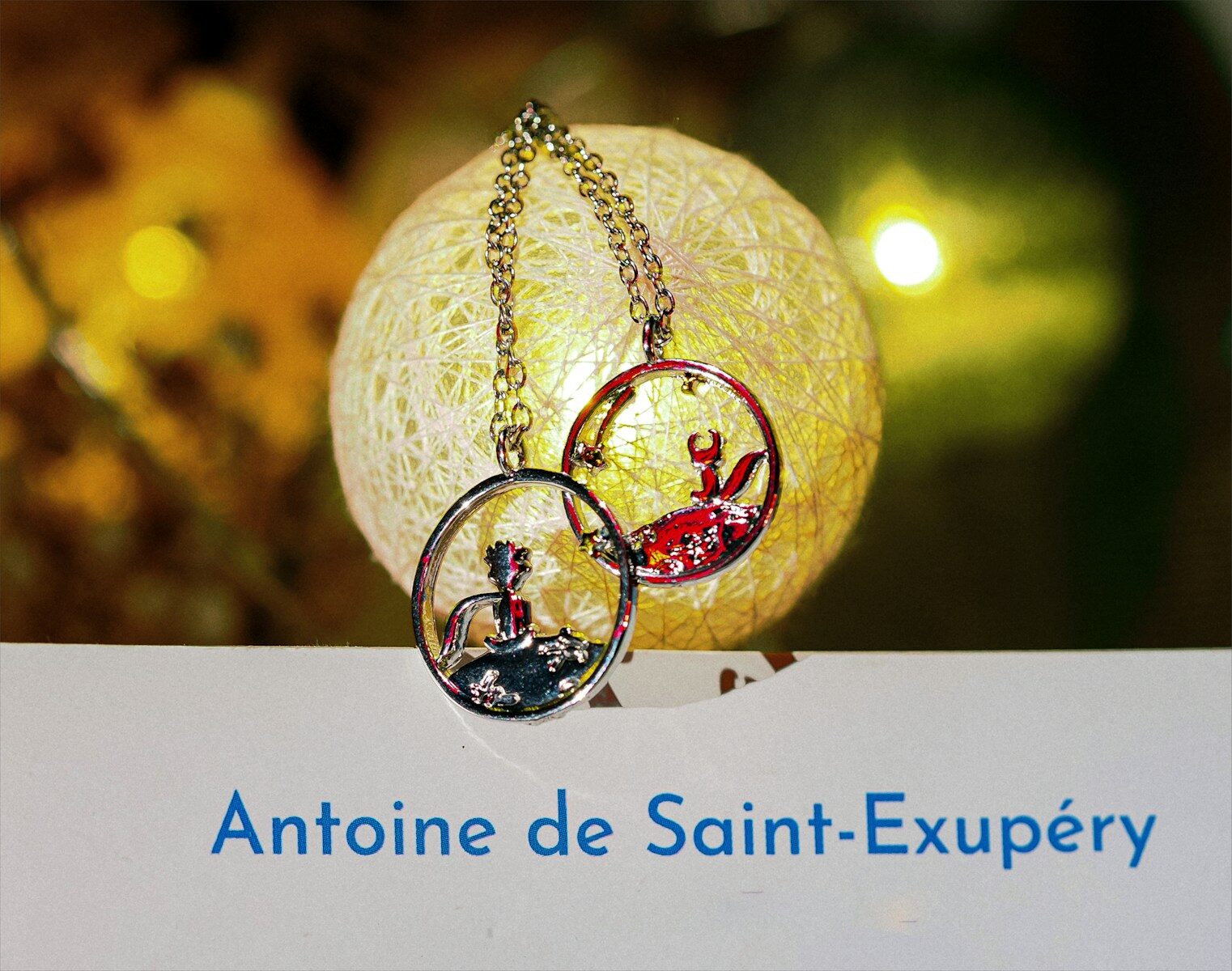
The Little Prince
If these reflections resonated with you, you are welcome to share it further.
Or what we forget to keep seeing, as we grow
There are stories I read as a little girl and believed, for a long time, were simply sad.
The Little Prince was one of them. I remember the drawing of the boa constrictor that had swallowed an elephant — and the way every grown-up in the story saw, in its place, only a hat. As a child, I understood instantly what was wrong with that. As an adult, I understood something else entirely: how easily we forget, as we grow, exactly that way of looking.
Read again now, the story no longer seems to be about a tiny planet and a strange prince. It seems to be about what happens to us on the road between seeing through the eyes of someone still amazed by the world, and seeing only through the eyes of someone who has learned to count, to calculate, to move on.
The story
A pilot, stranded after a breakdown in the Sahara desert, meets a strange boy who appears out of nowhere and asks him, with complete seriousness, to draw him a sheep.
That's how their friendship begins. From the stories the boy tells him, the pilot understands that the boy comes from a very small planet, where he left behind a single rose — a vain, fragile flower he tended with patience, but grew so tired of, at one point, that he set off, traveling from planet to planet. Along the way he meets, in turn, a lonely king, a vain man, a drunkard, a businessman busy counting stars he believes belong to him, a lamplighter, and a geographer. Once he reaches Earth, in the desert, he meets a fox, who asks the prince to tame him — and who explains, as they part, what it truly means to form a bond with someone.
Toward the end of the story, the prince prepares to return to his flower by letting a snake bite him, so his heavy body can fall away behind him, like an old shell. The next day, the pilot, who by then had repaired his plane, can no longer find the prince's body. He is left alone in the desert, with no certainty about what really happened, looking at the stars with different eyes than before.
A mirror, not a diagnosis
As with every story in this thread of thoughts about stories and inner worlds, a caution is worth repeating: the fact that a story has stayed close to us since childhood doesn't, by itself, say anything definitive about us. It doesn't mean every child who loved The Little Prince lived through the same experience, nor that the story "explains" a particular wound.
But we can, as always, look at it as a symbolic mirror — not for a verdict, but for a question: what part of me recognizes itself in this child who still sees with the eyes of the heart, in a world full of grown-ups who have forgotten how?
The boa constrictor and the hat, or on not being seen
The book's first image is also one of its most painful, even though it seems merely funny.
The narrator, as a child, draws a boa constrictor that has swallowed an elephant. He shows the drawing to the grown-ups around him. Every one of them, without exception, sees a hat. Not because they're foolish, but because they stopped, long ago, looking past the simplest, most convenient shape of things. The child gives up drawing. He chooses, instead, a "serious" profession — and carries forward with him the experience of a world that wasn't able to see what he saw.
It's an experience many of us recognize, even if we've never named it quite this way: the moment you showed someone something that mattered to you — a drawing, an idea, a fear, a joy — and got back only a simple, flat explanation that had nothing to do with what you meant. Not every child who goes through this ends up, like the narrator, keeping people at a distance. But many of us carry, somewhere, the memory of that moment when we understood that being seen isn't guaranteed — sometimes it has to be found.
The grown-ups' planets, or portraits of a loneliness grown large
Before reaching Earth, the prince visits a series of tiny planets, each inhabited by a single adult, caught inside a single idea about himself.
The king rules over an empty planet, giving orders no one is there to receive. The businessman spends his days counting the stars, convinced that counting them means owning them — without ever pausing to actually look at them. Each of these grown-ups is caught in a form of loneliness he built for himself, believing it protects him, or proves something important about who he is.
The prince looks at each of them with a wonder free of unkindness, and moves on, unable to understand why an adult would choose to live this way. Maybe it's exactly this wonder — not judgment, just honest bewilderment — that we lose most often on the road to adulthood: the ability to notice a form of loneliness without normalizing it simply because we've come, in turn, to live inside our own.
The fox, or what it means to tame
Of all the prince's encounters, the one with the fox remains, I think, the most important.
The fox asks the prince to tame him — not in the sense of domesticating him, but in the sense of building, with patience and time, a bond. He explains, with a simplicity that holds up no matter how many times you reread it, that before being tamed, he was nothing more to the prince than a fox like a hundred thousand other foxes, just as the prince was nothing more to him than a boy like a hundred thousand other boys. But if they tame each other, they will need one another. They will become, to each other, unique in all the world.
It may be the clearest definition of love you can find in a children's story: not something that happens instantly, but something built, time and attention given to one particular relationship, until that relationship becomes irreducible to any other. And it's the fox, too, who speaks the truth holding the whole book together: it is only with the heart that one can see rightly; what is essential is invisible to the eye.
The rose, or what makes something irreplaceable
On Earth, the prince discovers a garden with five thousand roses identical to his own. The discovery crushes him: the flower he believed unique in the universe is, in fact, one among many.
Only later, with the fox's help, does he understand the difference. His rose isn't special because she's different from the others. She's special because he spent time with her — watered her, sheltered her from the wind under a glass globe, listened to her complaints, let himself, at times, grow exasperated by her vanity. The time he lost on that flower is what made her irreplaceable, not some objective quality the other roses lack.
It's an idea that runs straight against a very modern reflex: the habit of comparing, of believing something precious could easily be swapped for something just as good, simply because it looks similar on the surface. The story suggests the opposite — that value doesn't come from the objective uniqueness of the thing we love, but from the time and attention we chose to give it.
The symbolic figures of the story
The Little Prince is the child who still sees the essential — the one who hasn't forgotten that a drawing can hide an elephant swallowed by a snake, even when the rest of the world sees only a hat.
The fox is the relationship that teaches love as a bond built over time, not as ownership or chance.
The rose is what we love and, sometimes, don't know how to value until we leave her side — or until we discover she wasn't, after all, the only one of her kind.
The grown-ups on the small planets are the shapes loneliness can take when we build it, without meaning to, around a single idea about ourselves.
And, perhaps easiest to overlook, the pilot — the adult who, in the desert, had almost forgotten how to draw a sheep, and whom meeting a child slowly reminds how to see with the heart. He is the one who carries the story forward, alone, never certain what really happened.
About the story and its author
The Little Prince was written and illustrated, with the author's own watercolors, by Antoine de Saint-Exupéry, a French writer and aviator, and first published in 1943, while he was living in exile in the United States, in the middle of the Second World War.
The book has explicit roots in his own life: in 1935, Saint-Exupéry himself crashed his plane in the Sahara desert, where he wandered for several days before being found — an experience that seems to have fed directly into the story's setting.
There's an unsettling echo, though not necessarily an intentional one, between the book's ending and the author's own life: just a year after publication, in 1944, Saint-Exupéry disappeared during a reconnaissance flight over the Mediterranean. His plane wasn't identified until decades later, and his body was never found. Readers ever since have often felt that the story's ending — a departure with no body, no certainty — seems, without knowing it, to have foreshadowed his own.
A departure that never received a full explanation
What moves me most, rereading the book now, isn't the prince's death — or departure, whichever word we choose. It's what's left for the pilot afterward.
He finds no body. He has no clear proof of what happened. He has only an absence, a suspicion, and some stars he can never look at the same way again. Many of us know this particular kind of grief — the grief of a departure with no full explanation, of a relationship that ends without one last clear word, of a person who vanishes from our life leaving behind more questions than answers. Most of the time, we don't get clean endings. We get absences we slowly learn to carry.
Maybe that's why the pilot, at the book's close, doesn't ask the reader to find out what really happened. He only asks that, if you ever see a child somewhere in the desert, you write to him quickly and tell him the prince has come home.
Maybe it isn't the fox, or the rose, or even the prince himself that stays with us, in the end. Maybe what stays is only the habit, so fragile, of looking at the sky differently.
The Tao of Pooh – how simplicity can guide us back to ourselves
Share this article
Support the article library
If this article has been meaningful to you and you’d like to support this project, you’re welcome to make a voluntary contribution.
This contribution helps me continue writing freely and developing the resource library about body, soul, rituals, emotions, and inner transformation.