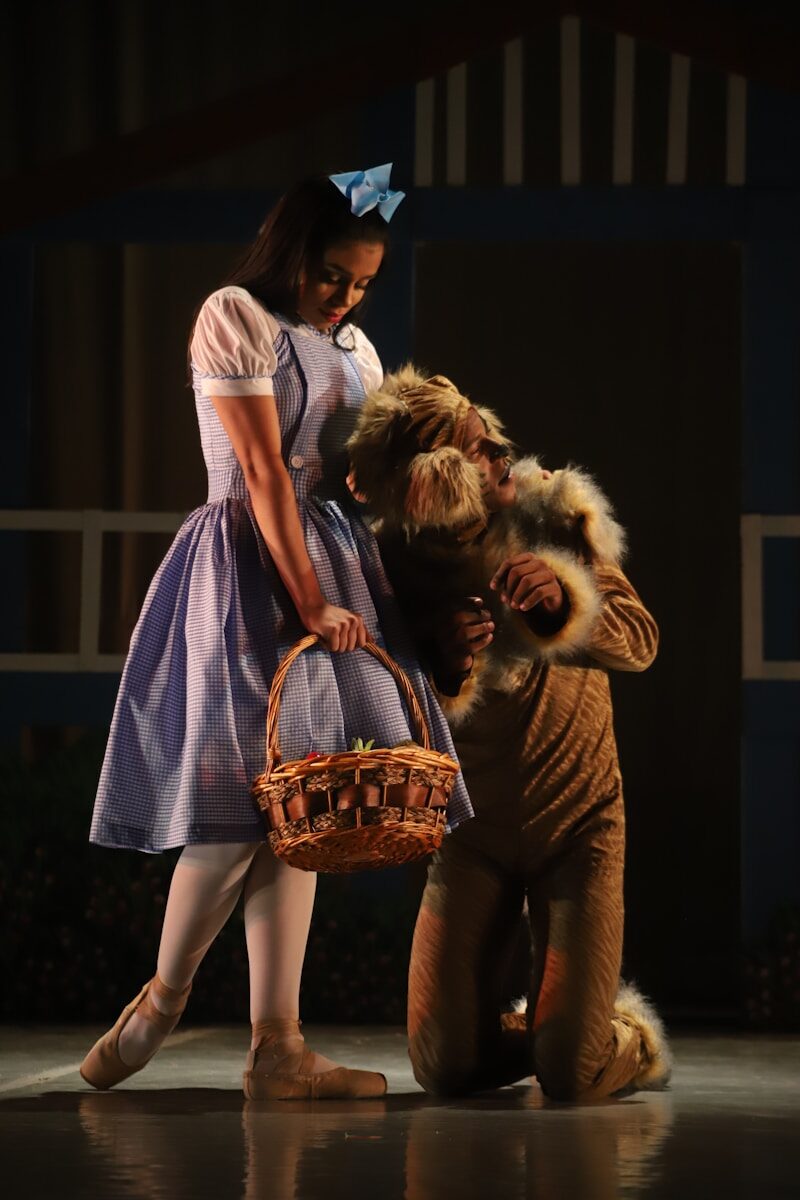
Dorothy and the Wizard of Oz
If these reflections resonated with you, you are welcome to share it further.
Dorothy and the Wizard of Oz — or why sometimes we travel so far to find what we already had
There are stories we read as children and only understand years later.
The Wizard of Oz is one of them.
At first glance, it's a colorful adventure: a little girl lands in a strange world, makes a few unlikely friends, and sets off toward a city where an all-powerful wizard is supposed to solve everything for her. That's how I read it the first time — as a story about someone else, a world that had nothing to do with mine.
Read again later, with different eyes, it says something else. It speaks about how we spend a good part of our lives searching outside ourselves for things that, little by little, we discover we've been carrying with us the whole time.
The storm
Everything begins with a storm, and I don't think that's an accident.
In stories, storms are rarely just about weather. They show up when an old world can no longer hold — when something has to break apart for something else to settle into place.
Our lives have storms like that too. A breakup. Losing someone. An illness. A question that refuses to leave us alone. Suddenly what was familiar is gone, and we find ourselves pulled out of the place where we thought we knew who we were, dropped into territory with no map.
Exactly like Dorothy.
The road to the Emerald City looks, at first, like a road toward someone who has the answers we can't find. Only later do we understand it's actually a road back to ourselves — and that the whirlwind tearing us out of the old world isn't only a loss. It's also where a new movement quietly begins, before we even notice.
The Scarecrow, or the mind that believes it isn't enough
Along the way, Dorothy meets three companions, each convinced something essential is missing in them.
The Scarecrow is sure he has no brain. And yet, at every turn, he's the one who finds solutions where everyone else sees only walls. He observes, improvises, understands before the others do. It isn't intelligence he lacks. It's only the confidence that he has it.
It's a familiar shape of thought, because most of us have lived inside it too. It's the voice that keeps insisting I'm not smart enough, good enough, ready enough,no matter how much evidence says otherwise — not because it's true, but because it has simply learned to speak louder than the evidence.
The Scarecrow doesn't need a new brain. He needs to notice what he's already doing from the very first step of the road.
The Tin Man, or the heart too tired to feel
The Tin Man says he has no heart. And yet he's perhaps the most sensitive of them all — he tears up, he aches for others, he notices every small kindness around him.
He hasn't lost the capacity to feel. He's only forgotten, somewhere along the way, that he still has it.
We do the same, often. After enough disappointment, we don't stop loving. We only stop believing it's safe to. And without quite noticing, we build a shell of tin over something that keeps beating anyway. The difference between the Tin Man at the start of the story and the one at the end isn't that he grew a new heart. It's that he finally let the old one show.
The Lion, or courage that moves forward while trembling
The Lion calls himself a coward at every turn. But when his friends are in danger, he's the first to leap.
His courage doesn't arrive after the fear disappears. It shows up while his voice is still shaking.
Maybe that's one of the most beautiful truths tucked inside this story: courage isn't the opposite of fear. It's the choice to keep walking alongside it, not after it's gone. So often we wait to stop being afraid before we act — and in doing so, we postpone the very step that would show us fear and courage can share the same room.
The Wizard behind the curtain
And then there's the Wizard.
Everyone sees him as the man who holds all the answers. Powerful, impressive, all-knowing — until someone finally pulls the curtain aside. And underneath is an ordinary man. Not cruel, not a fraud in the simple sense of the word. Just someone who tried, with everything he had, to seem bigger than he felt on the inside.
It's a strikingly familiar image. We live in a world where many of us become, in turn, our own wizard: trying to look like we have it all together, hiding uncertainty behind performance, believing vulnerability has to stay behind a curtain, as if it were something shameful rather than simply human.
Maybe the story's most important lesson is exactly this: the authority we so often search for outside ourselves is sometimes only the projection of our own need to believe that someone, somewhere, actually knows.
Dorothy, or the child looking for the way home
Dorothy says, from the very start, that all she wants is to go home.
As children, we thought she meant a farm in Kansas. Reading the story again now, she seems to mean something else. "Home" isn't necessarily a place. It's a state — the place where we no longer have to prove anything, where we can breathe without calculating every gesture, where we stop trying to become someone else just to be kept.
Only at the end of the road does Dorothy learn that the shoes she'd been wearing from the very beginning had the power to take her home all along. She didn't need to find something new. She only needed to discover what she was already carrying, without knowing it.
Why these stories bring us back to ourselves
Why these stories bring us back to ourselves
They don't ask us to understand everything at once. They only ask us to feel — and for a few pages, they give us a safe distance from which to watch a dynamic without being overwhelmed by it. Maybe that's why a story about a little girl, a scarecrow, a tin man, and a lion can sometimes say more than a whole year of explanations about ourselves.
Because each of them is, at heart, a simple part of us: the doubt that mistakes itself for a lack of intelligence, the heart too tired to come out into the open, the courage that never actually stopped trembling, the need to look like we have everything under control, and the child who's still asking where she belongs.
And each of these parts needs the same simple thing: to be seen, without hurry, exactly as it is.
Maybe we don't lose ourselves because something is missing. Maybe we lose ourselves because, along the way, we forget what we're already carrying.
We go looking for validation, courage, love, clarity, safety. We project them onto a teacher, a book, a therapist, a relationship, a success we believe will finally change our life. And without realizing it, every step we take outward brings us a little closer to what's inside.
Maybe that's the real meaning of the road through Oz. Not to find what we're missing, but to discover that, most of the time, we were never missing it at all. We just needed a journey long enough to be able to believe that.
And "home" was never a destination. It's a reminder.
The Tao of Pooh – how simplicity can guide us back to ourselves
Share this article
Support the article library
If this article has been meaningful to you and you’d like to support this project, you’re welcome to make a voluntary contribution.
This contribution helps me continue writing freely and developing the resource library about body, soul, rituals, emotions, and inner transformation.