The Tao of Pooh – how simplicity can guide us back to ourselves
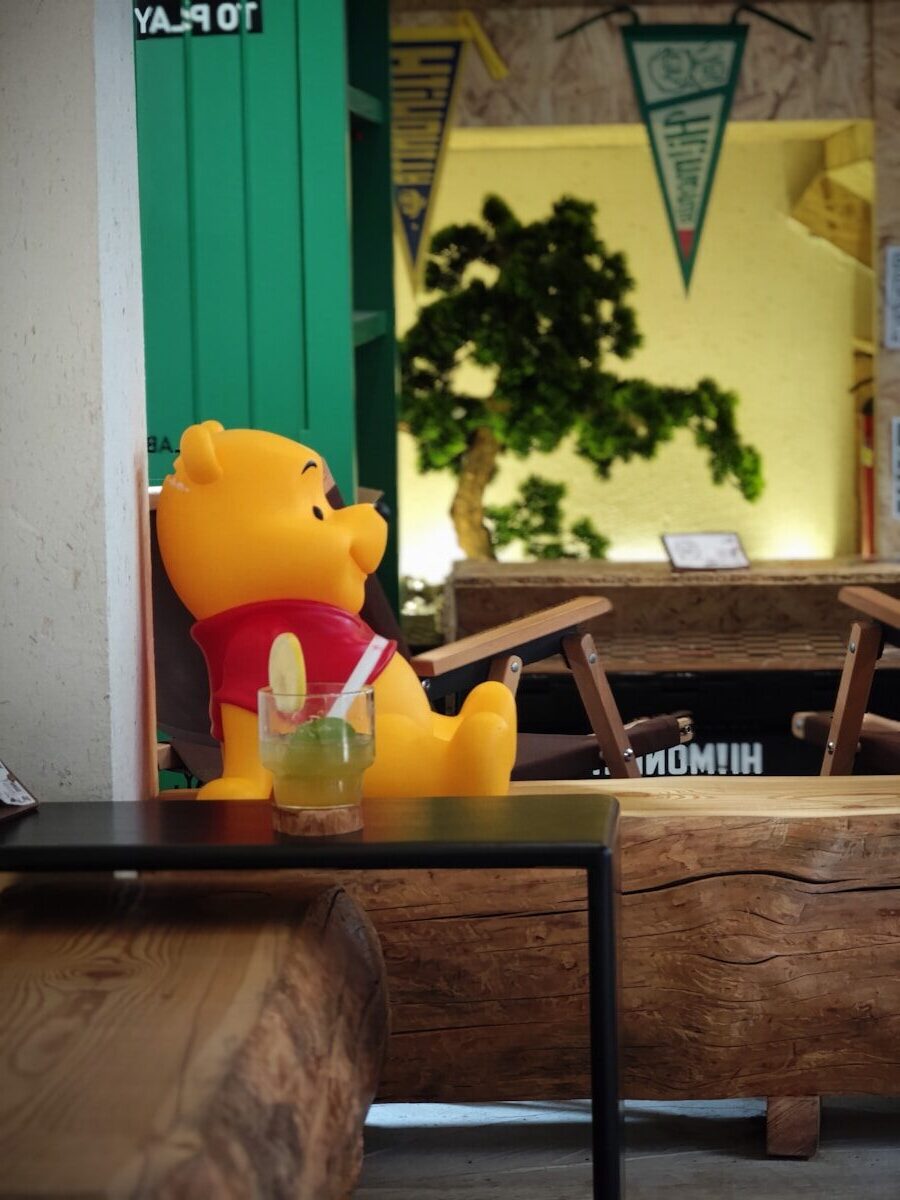
If these reflections resonated with you, you are welcome to share it further.
Tao-ul lui Pooh – Benjamin Hoff
There are books that don’t come to you as readings, but as encounters. Books that are not read only with the mind, but settle into the body, into the breath, into the places you haven’t yet reached through words.
For me, The Tao of Pooh appeared on a Monday morning, in a moment of inner crossroads. I was between two directions, between two versions of myself, in a suspended space where I no longer knew whether to push forward or to stop.
And someone simply said: “Read this.”
I opened the book with a kind of gentle surrender, as if I were stepping into a river that knows better than I do where it’s flowing. And as I read, I kept finding myself asking:
- “Is this what I do?”
- “Am I doing things from the right energy?”
- “If this message arrives now, what is it that I still need to learn, to rearrange, to allow?”
And I understood quickly that this book is not just about Taoism, or Pooh, or Eastern philosophy. It speaks about the way modern humans have slowly drifted away from their own inner rhythm.
About the exhaustion of trying to control everything. About the constant need to become “more,” even when the soul is asking for less. About the difficulty of simply being with ourselves.
And, most of all, about the fact that sometimes healing begins exactly when we stop forcing everything so much.
When a book arrives at the exact moment you need it
There are encounters that are not accidental.
Some books appear precisely when a person begins to tire of their own hurry, their own explanations, their constant need to find solutions for everything.
That’s how this book came to me: as a simple question, sharp in its sincerity: “What if life doesn’t need to be pushed forward all the time?”
Perhaps one of the greatest fractures of modern life is this continuous struggle with reality.
We see it everywhere:
- in people who can’t go to bed without checking their phone one more time,
- in those who turn rest into another form of productivity,
- in those who feel guilty if they spend a few minutes not “doing something useful.”
We try to speed up processes. To control emotions. To “fix” pain. To become someone else before understanding who we are.
And maybe this is where the beauty of Taoism begins: not as an abstract philosophy, but as a way of being in the world.
Why Pooh seems wiser than everyone else
As you move through the book, you begin to notice that each character reflects a part of us:
Rabbit — the part that over-organizes and tries to keep the world in order through constant effort.
Owl — the mind that analyzes everything until direct experience disappears under the weight of explanations.
Tigger — the agitation, the impulse to run away from stillness.
Eeyore — the heaviness, the melancholy, the sense that life has become too much.
And then there is Pooh.
Simple, present, uncomplicated. So natural that he seems to know something the others have forgotten.
Maybe wisdom doesn’t always come from complexity. Sometimes it comes from an honest closeness to simple things.
„People say nothing is impossible, but I do nothing every day.” — Winnie-the -Pooh
Wu Wei – the art of not forcing life
One of the central ideas of Taoism is Wu Wei — action without force.
Not passivity. Not giving up. Not lack of involvement.
But the ability to move with the rhythm of life instead of pushing against it.
Water doesn’t force, and yet it shapes stone. Nature doesn’t hurry, and yet everything transforms.
Perhaps many of our sufferings appear because we try to control even what needs natural time to settle: healing, relationships, the body, emotions, life itself.
„The things that make me different are the things that make me.” — Piglet
In constellations, I see this constantly. People enter the space with the tension that they must understand everything, fix everything, leave “healed.”
And then, sometimes, the shift appears in a very small moment.
In a deeper breath. In a silence. In the instant someone stops defending themselves and simply says: “Yes… this hurts.”
When a person stops pushing, the field begins to breathe.
Simplicity is not the opposite of depth
One of the revelations of this book is that simplicity and depth do not exclude each other.
Modern humans often associate depth with complexity, but emotional maturity may mean the opposite: becoming honest enough to return to what is essential.
Sometimes:
- a real conversation,
- a slow walk,
- a conscious breath,
- a lit candle,
- a moment of stillness,
transform more than years of explanations.
Maybe the soul doesn’t always need another method. Sometimes it needs less struggle.
Things are as they are
One of the hardest emotional lessons is accepting reality as it is. Not because we don’t see the truth, but because we often cannot bear it.
The mind lives between:
- “it should have,”
- “it shouldn’t have,”
- “why me,”
- “I don’t accept this.”
But transformation begins in honest contact with reality, not in fighting it.
Acceptance is not resignation. It is seeing the truth without distorting it: Yes, this is my story. Yes, this is my emotion. Yes, this is the place I’m starting from now.
And maybe this is exactly where real movement begins.
Returning to one’s own nature
The book speaks constantly about the nature of each being.
A fish doesn’t climb trees. A bear doesn’t become an owl. A tiger is not a rabbit.
And yet people spend their lives trying to be what they are not.
- Sensitive people trying to become tough.
- Intuitive people trying to live only in the mind.
- Gentle people believing they must be aggressive to survive.
- Creative people trying to control everything.
„Sometimes the smallest things take up the most room in your heart.” — Winnie-the-Pooh
The body grows tired.
Because there is a difference between development and self-denial. Returning to oneself does not mean copying an ideal “healed” version of a human. It means understanding who you are beneath all the masks built for survival.
The body knows before the mind
Owl and Rabbit try endlessly to understand, organize, and control.
Pooh feels. Not because he is “less intelligent,” but because he is not cut off from direct experience.
Today we know so much about trauma, attachment, anxiety, the nervous system, the inner child. And yet so many people live in constant alertness. You see it at traffic lights, switching compulsively between apps. You see it on vacations where rest never arrives. You see it in people sitting with loved ones but unable to be truly present.
Because there are truths the body understands long before the mind can explain them. This is why, in constellations, in ritual work, in somatic practices, we don’t work only with explanations. We work with rhythm, with breath, with silence, with subtle movements, with what appears spontaneously.
Healing doesn’t always begin through struggle
One of the great modern confusions is the belief that healing must be spectacular.
But sometimes healing begins quietly:
- in a softer breath,
- in a gentler choice,
- in a moment when a person stops abandoning themselves.
Control, perfectionism, hypervigilance, the need to save — all were once forms of survival.
Healing doesn’t mean destroying them. It means understanding why they appeared.
In place of a conclusion: am I pushing life, or moving with it?
Since reading this book, I sometimes catch myself pausing for a few seconds and asking: “Am I pushing life right now, or moving with it?”
Maybe this is one of the most important questions we can ask ourselves. Because there are moments when transformation doesn’t come from more control, but from more presence.
And in the spaces I hold today, I see this again and again: people don’t always change when they understand more, but when they stop fighting themselves so hard, even for a moment.
Maybe we didn’t drift away from ourselves because we don’t know enough.
Maybe we drifted because we forgot how to simply sit with what we are.
Family constellations, systemic and multidimensional
About The Tao of Pooh and its author
The Tao of Pooh was written by Benjamin Hoff and first published in 1982.
The book uses A. A. Milne’s characters to explain, in a surprisingly simple way, the principles of Taoism — an ancient Chinese philosophy rooted in harmony, simplicity, balance, and natural flow.
Although it may seem light or even childish at first glance, The Tao of Pooh has become one of the most beloved modern introductions to Taoist philosophy precisely because it transforms profound ideas into simple, recognizable human experiences.
Share this article
Support the article library
If this article has been meaningful to you and you’d like to support this project, you’re welcome to make a voluntary contribution.
This contribution helps me continue writing freely and developing the resource library about body, soul, rituals, emotions, and inner transformation.