The illusion of progress – when information about transformation replaces transformation
If these reflections resonated with you, you are welcome to share it further.
The illusion of progress — a reflection on personal development, the culture of free content, and the difference between understanding an idea and living it.
We are living in an age of strange contrasts.
An era in which transformation has become a common language, a promise, an industry, a spectacle. An era in which we can talk for hours about healing, yet so few dare to actually live it.
We are the generation with the greatest access to information about psychology, trauma, spirituality, neuroscience, mindfulness, relationships, somatics, energy, meaning. In a single week you can attend a webinar on boundaries, a workshop on the inner child, an abundance challenge, a conscious relationships session, and several online meetings about energy or life purpose. You can follow dozens of therapists, coaches, authors, spiritual teachers. You can consume endless hours of content about transformation.
And yet, in the quiet space between two workshops, the question we instinctively avoid appears: Why do we know so much about change, yet change so little?
The illusion of progress
Daniel Kahneman describes a mechanism we all know, even if we don’t name it: the feeling that if we’ve understood something, we’ve already evolved.
Knowing ≠ doing.
The brain can confuse insight with transformation because both create a sense of clarity and relief. But one is mental, and the other is existential.
I’ve been there too. I’ve participated, read, understood. And sometimes I found myself using understanding as a comfortable place to stay, not a threshold to cross.
This is where what contemporary psychology calls sophisticated avoidanceappears: using personal development as a refined way to avoid truly touching yourself. We analyze ourselves without taking responsibility. We understand ourselves without changing. We keep busy with ourselves so we don’t have to meet ourselves.
This is not a criticism. It’s a subtle trap — one that catches precisely the people who are most sincere in their desire to grow.
Why we avoid with such elegance
Gabor Maté would say we don’t avoid transformation itself, but the pain that precedes it. We avoid confronting old wounds, invisible loyalties, inner truth. So we choose the elegant option: another workshop, another guide, another explanation. We keep ourselves occupied with ourselves so we don’t have to meet ourselves.
Carl Rogers called this incongruence — the distance between what we know and what we live. A distance that hurts, but one we mask through accumulating information. We feel “close”, “on the way”, “in the process”, yet we never enter real contact with change.
Joseph Campbell would immediately recognize this stage: the hero who receives the call but refuses it. We feel the call toward a more authentic life, but we remain at the threshold. We don’t enter the dark forest yet. We don’t accept the adventure. We don’t take the risk.
The culture of free content and the illusion of access
In recent years, the personal development industry has built an almost universal model: free webinar, free workshop, free masterclass, free challenge, free group, free guide, free content.
These are not philanthropic gestures, but marketing tools. Professionals offer value and hope — legitimately — that some people will later choose depth. There is nothing wrong with that.
But after years of free content, something unexpected has formed: a culture of permanent introductory consumption. People are encouraged to receive one more guide, one more challenge, one more surface-level experience — without ever being invited to go beyond it.
The problem is not free content itself. The problem is that free content creates the illusion of access, not real access. It keeps people in the introductory zone. It creates dependence on novelty, not on practice.
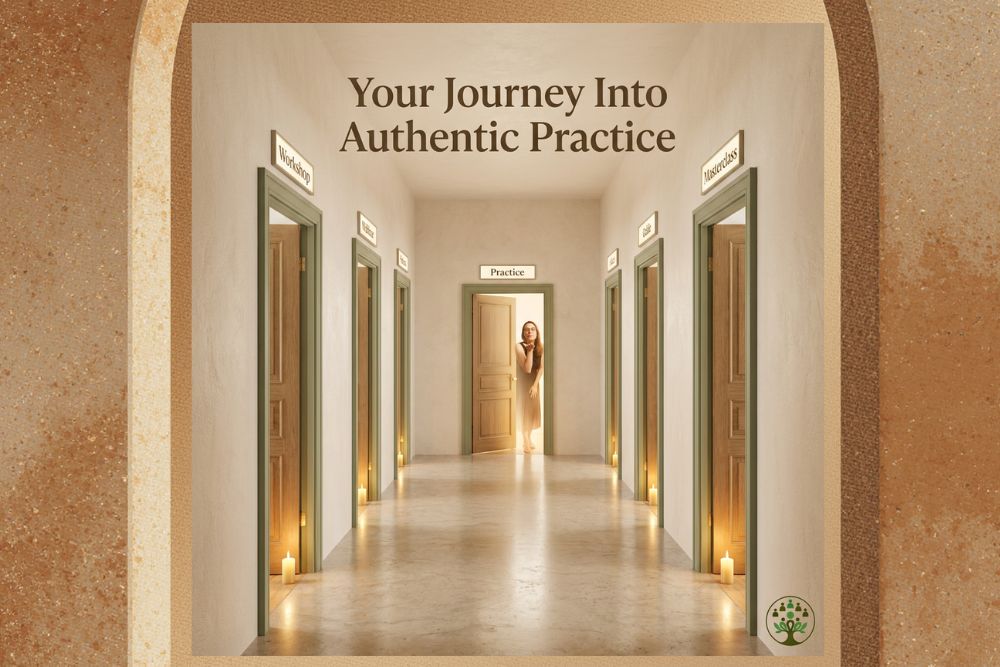
In many fields, free content is a doorway. And it should be. It can be the first contact with an idea, a practice, or a person who has something valuable to offer. The problem appears when the doorway becomes the destination. When we spend years in the introductory space. When we collect beginnings without ever entering a process long enough to transform us. This is how a new illusion is born: the feeling that we are always almost changing.
Free content opens the door. But it cannot make you walk through it.
The threshold information cannot cross
There is a moment in every real process of transformation when life asks something concrete from you: time, consistency, discomfort, vulnerability, practice — and sometimes a financial investment, not because change can be bought, but because the investment symbolizes a choice.
A moment when you no longer say “this is interesting”, but “I am willing to truly enter this process”.
Perhaps this is one of the most important differences between knowledge and transformation. Understanding is comfortable. Transformation is costly. Understanding asks for attention. Transformation asks for participation. Understanding can be consumed. Transformation must be lived.
Brené Brown would say the real threshold is not the insight. Not the theory. Not the workshop. But the moment you say:
- This is who I am.
- This hurts.
- This is what I avoid.
- This is what I choose.
Vulnerability is where courage begins, not understanding.
And James Clear would add that transformation doesn’t begin with big ideas, but with small, repeated actions that change who you are — not just what you know. Micro-actions require consistency, and consistency requires commitment. Exactly what we tend to avoid.
Once you cross that threshold, you can no longer remain just the observer of your own life. You must become a participant. You must become the author.
Maybe we already have enough information
Maybe one of the great challenges of our time is not the lack of information. Maybe we already have too much.
Maybe the real question is no longer “what else should I learn?”, but “what do I already know and still haven’t had the courage to live?”
Transformation rarely begins when we find the next idea. Most often it begins when we stop searching. When we stop preparing for life and finally choose to live it. Not perfectly. But with presence. With responsibility.
You can stop reading here and answer this question — not in your mind, but in writing. Three minutes. One thing.
What is the thing I already know, but still haven’t had the courage to live?
That is your next step.
Share this article
Support the article library
If this article has been meaningful to you and you’d like to support this project, you’re welcome to make a voluntary contribution.
This contribution helps me continue writing freely and developing the resource library about body, soul, rituals, emotions, and inner transformation.