If these reflections resonated with you, you are welcome to share it further.
What connects the I Ching to the genetic code, and what happens when a resemblance becomes a map of the self
"The I Ching and the genetic code are two ways in which the universe writes its story: one in Yin and Yang lines, the other in the letters A, T, C, G."
I have come across this idea many times, in different forms. Sometimes with an image: a hexagram next to the DNA spiral. Sometimes with a sentence that sounds like a confirmation: "Even scientists have studied the connection."
It drew me in immediately. A Chinese book nearly three thousand years old, made of 64 figures. The code of life, discovered only in the last century, made of 64 "words." Two systems that, at first glance, seem to count the same way.
And as I read, one question stayed with me: when we discover a resemblance between two things, are we discovering something about them, or something about the way our minds work?
Perhaps the answer is not one or the other.
A book for crossroads
I Ching, the "Book of Changes," was not written as a treatise on nature. At first, it was a book people consulted when they did not know what to do. Before a journey, a marriage, a battle. Later, generations of scholars added commentaries, and the book also became a philosophy of how things change.
Everything begins with two lines: an unbroken one, linked to yang, and a broken one, linked to yin. Stacked six at a time, the lines form figures called hexagrams. There are 64 of them, because that is how many combinations six lines with two options each can produce.
It would be easy to stop here and say: yin is 0, yang is 1. But that would mean losing the most beautiful part of Chinese thought.
Yin and yang are not two fixed values, like a switch that is either on or off. They are complementary aspects of the same thing, existing through each other and turning into each other. Day passes into night, winter into spring, rest into movement. Each carries the seed of the other. Nothing is only yin or only yang, but more or less so, in relation to something else and at a given moment.
Nor are the hexagrams mere combinations. Each describes a situation: a difficult beginning, waiting, conflict, fulfilment, the moment before fulfilment. What matters is the position a line holds, and how the two halves of the figure relate to each other. And, above all, the changing lines. When someone consults the book, some lines may come out "moving," ready to turn into their opposite. And the hexagram they are moving toward says something about the direction of the change.
This leads to a distinction I find essential. Mathematics tells us how many configurations are possible. The I Ching tries to explore what change means in a lived situation. A code of zeros and ones can describe a configuration. But it does not, by itself, give it a meaning.
A book written in every cell
The genetic code is, in a way, also a book. One written in every cell of our body.
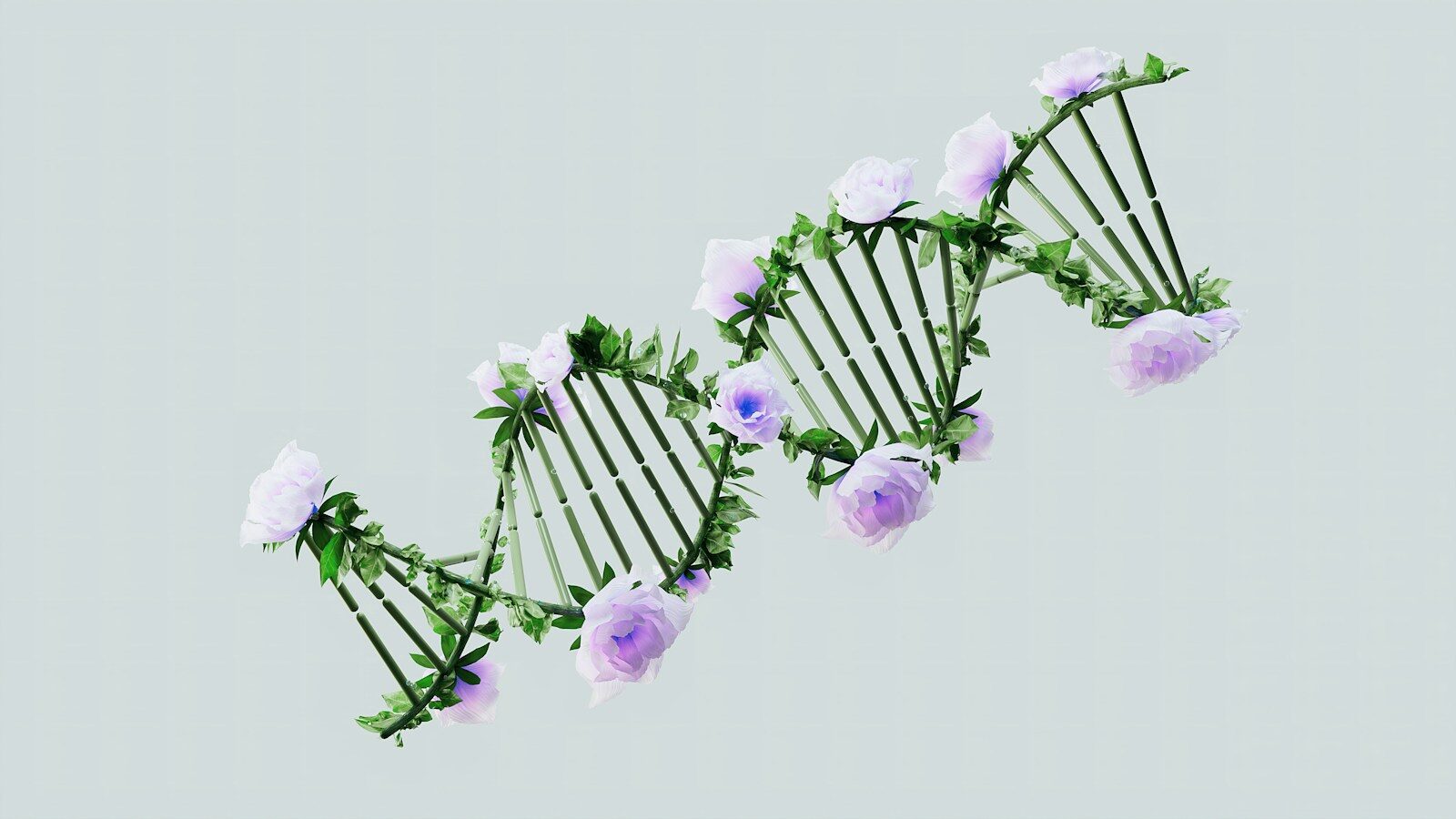
In DNA, its alphabet has four letters: A, T, C and G. When a cell wants to use a piece of information, it makes a working copy of it, called messenger RNA. In this copy, the letter T is replaced by U. That is why the "words" of the genetic code are usually written with the letters A, U, C and G.
The letters are read three at a time. Each group of three, called a codon, tells the cell which "building block" to add when it builds a protein. These building blocks are called amino acids.
With four letters, three-letter words can be formed in 64 ways.
The same number, a different kind of 64
This is where the resemblance becomes interesting. And, at the same time, shows its limits.
In I Ching, 64 comes from six positions, each with two possibilities: 2⁶ = 64.
In the genetic code, 64 comes from three positions, each with four possibilities: 4³ = 64.
The same result, built differently. A little like arriving at the same number of steps along two different roads.
There is another difference, a deeper one. The 64 hexagrams are 64 distinct situations, each with its own meaning. The 64 codons do not mean 64 different things. Sixty-one of them code for only 20 amino acids, and the other three are "stop" signals, telling the cell where the protein ends. So several codons can "say" the same thing. Some amino acids have six different words, others just one.
That is why, sometimes, a changed letter does not alter the amino acid that word codes for. At other times, the change can have important consequences. In the I Ching, a changed line always leads to a different situation.
Two systems can share the same size without sharing the same organization or the same function. To me, that is exactly what makes the comparison richer, not poorer.
Who noticed the resemblance
The parallel was noticed almost as soon as the genetic code was deciphered, in the 1960s.
In 1969, the molecular biologist Gunther Stent mentioned it in his book The Coming of the Golden Age. In 1973, the German physician Martin Schönberger devoted an entire book to it, Verborgener Schlüssel zum Leben , published in English in 1979 as The I Ching and the Genetic Code. In 1991, Johnson F. Yan published DNA and the I Ching. Since then, the idea has been taken up in dozens of books, articles and diagrams.
There is another, older story that gave this idea courage: that of Leibniz. The German philosopher and mathematician had been working for years on a way of writing numbers using only 0 and 1, the binary system that computers use today. Only later, through the Jesuit missionary Joachim Bouvet, who was living in China, did he receive a diagram of the 64 hexagrams, arranged in an order associated with the tradition of Fu Xi. Leibniz was amazed to recognize in it, reading the unbroken line as 1 and the broken line as 0, his own sequence of numbers.
It is important to tell this in the right order: Leibniz did not discover the binary system thanks to the I Ching. He recognized it there, after he had already built it. And this very encounter says something: he saw in the hexagrams what his mind was ready to see.
What the studies say, and who decides the order
When I looked at studies circulating around this idea, I found something similar to the story of "five thousand years of astrology": a powerful sentence resting on things more modest and more varied than it lets on.
Some of these texts are opinion pieces or hypotheses, honestly presented as such: the authors propose that the order of the hexagrams might describe rhythms in the body, but they have not tested it. Others use the figures of the I Ching as beautiful labels for things biologists already knew. One appears in a very well-known technical database, which gave the impression that a major scientific organization had confirmed the connection. It has not: the database hosts papers from thousands of conferences, and being included there is not a confirmation. There are also researchers who use mathematics to describe the structure of the genetic code and who have drawn inspiration from the I Ching. Their work shows that an elegant mathematical model can be applied to both systems. That is different from showing that one system "anticipated" the other.
And there is one more question, rarely asked by those who draw these maps: who decides the order?
I Ching works with two kinds of lines. The genetic code, with four letters. To place them side by side, you have to translate one into the other. It is a little like translating a poem. You can keep the rhyme and lose a nuance. You can keep the nuance and lose the rhyme. Every translator chooses differently.
Let us take two rules of correspondence, equally coherent mathematically. In the first, the codon that usually marks the start of protein production falls on the hexagram "Pushing Upward." A beginning that rises; it is hard not to be moved. In the second, the same "Pushing Upward" lands on a codon that stops protein production.
And that is only part of it. The hexagrams can be arranged in several traditional orders: the order in the book, called King Wen, and the Fu Xi order, the one Leibniz saw. Codons, too, can be ordered by chemical or mathematical criteria. If we choose one order for one and another for the other, we can obtain very suggestive correspondences. But what would make one of them more convincing than the others?
It is worth distinguishing four things that easily get mixed up:
- an observed resemblance: both systems have 64 units;
- a constructed correspondence: we choose rules in order to place them side by side;
- a hypothesis that can be tested: if the connection is real, then we should find something specific in nature that we do not yet know;
- a demonstrated relationship: the hypothesis has been confirmed by evidence independent of the way we built the map.
For now, the parallel between the I Ching and the genetic code sits between the first two. I have not found a study in which such a map predicted something new about the genetic code that was later confirmed. To date, there is no solid, widely accepted scientific evidence that the I Ching describes the genetic code.
That does not make the resemblance false. It does, however, make it ours. The correspondence is not an inscription found on a wall. It is a map we draw ourselves.
When a resemblance becomes a map of the self
The story did not end with books and diagrams. The parallel took a further step, perhaps the most important one.
In 1987, Alan Robert Krakower, who would become known as Ra Uru Hu, laid the foundations of the system called Human Design. It combines astrology, the I Ching, the Kabbalistic Tree of Life and the chakra system into an individual chart, calculated from the date, time and place of birth. Here, the 64 hexagrams become 64 "gates," also explicitly linked to the 64 codons of the genetic code.
A few years later, Richard Rudd, who came from Human Design, developed the Gene Keys. The system explores 64 keys, each with three levels: a shadow, a gift, and a state of spiritual fulfilment he calls the siddhi. The language of genetics is present in the very name, and in the way the keys are grouped.
Let us look at the road travelled:
I Ching: 64 hexagrams, life situations and their transformation.
The genetic code: 64 codons, the words through which the cell builds its proteins.
Human Design and Gene Keys: 64 gates and keys that speak about who you are.
And here comes the great leap: the passage from describing the world to interpreting the person. From "there are 64 possibilities" to "these 64 possibilities say something about who I am."
When a mathematical analogy becomes a map of identity, something changes. We no longer ask only how two systems resemble each other, but what they say about my life. And that question can no longer be answered by a microscope.
I do not think we need to look at these systems with suspicion. For many people, they have real contemplative value. They offer a language for self-observation, a mirror, a starting point for questions about their own lives. Human Design even includes an invitation not to accept the system on faith alone, but to explore it through personal experience. But checking whether an interpretation makes sense for your own life is not the same as demonstrating the biological mechanism the system invokes.
I simply think it is worth keeping one distinction clear: the fact that these systems use the language of genetics does not mean their interpretations describe genetic mechanisms. A gate in Human Design or a key in the Gene Keys has no demonstrated link to our genes and does not determine our traits. Their value, where it exists, lies elsewhere: in what they help us see about ourselves.
And another question arises. What do we do with these maps once we discover them? Do we use them as a starting point for observing ourselves, or do we end up defining ourselves through them? A map can open possibilities, but it can also narrow them when an interpretation becomes a label. Perhaps the value of such a system lies not only in what it says about us, but also in the freedom we keep not to reduce ourselves to what it says.
Why it draws us in so strongly
The human mind looks for patterns. In clouds, in repeating numbers, in birth dates, in the sky. It is one of our oldest abilities. And when we find an elegant pattern, we feel a small joy, as if the world had become, for a moment, easier to understand.
There is also the wish for ancient wisdom and modern science to meet. So that we do not have to choose between them. And perhaps something deeper still: the need to feel that life has a language. That we are not only chance, but also text.
But I would not want to leave the impression that only people drawn to symbols look for patterns. Science does too. Many discoveries began with noticing a regularity, a symmetry, an unexpected resemblance.
Perhaps we are not wrong to notice resemblances. The difference lies in the next step. Some of us ask what the resemblance means for our lives. Others ask what should happen in nature if the connection is real. Sometimes the same observation can open both paths. But an answer found on one of them does not automatically confirm the other.
What remains
When I started, I wondered whether the I Ching "knew" something about DNA. Now I think the question was the wrong one.
I Ching is a system for interpreting change. The genetic code is a biological system through which life passes on its information. Human Design and the Gene Keys are attempts to turn the meeting of these two worlds into a language of identity and meaning. Each answers a different question. And we do not need to reduce them to one in order to appreciate them.
We have no evidence that the I Ching describes the genetic code. But the question of why nature and human thought sometimes produce such similar structures remains, for me, fascinating.
Perhaps, looking at a hexagram and a DNA spiral, we discover something about the world. Perhaps we discover something about ourselves. Perhaps, most often, both at once.
Perhaps the I Ching and the genetic code are not necessarily two ways in which the universe writes its story. But they are, without a doubt, two ways in which people have tried to read it.
❤️ Support the article library
If this article has been meaningful to you and you’d like to support this project, you’re welcome to make a voluntary contribution.
This contribution helps me continue writing freely and developing the resource library about body, soul, rituals, emotions, and inner transformation.