
If these reflections resonated with you, you are welcome to share it further.
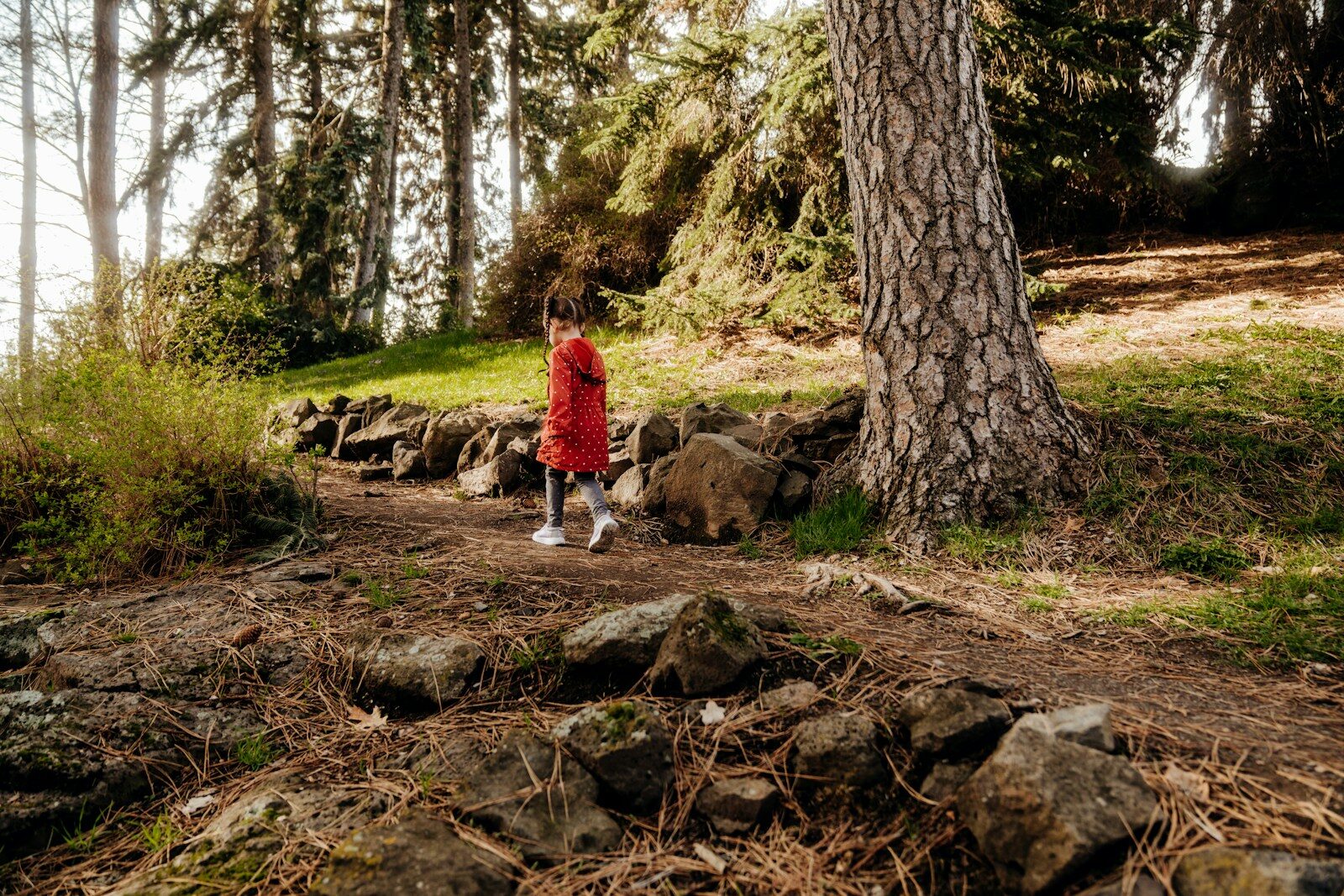
Little red riding hood — or the loneliness in the forest
There are stories that, as children, we listened to with our breath a little caught.
Little red riding hood was one of them. At first hearing, it seems simple: a little girl walks alone through a forest, carrying something precious in her arms, on her way to her grandmother. She doesn't know yet — because no one can know in advance — that the world isn't always safe.
Read again as an adult, the story no longer seems to be only about a wolf and a girl. It seems to be about a trust given too early, about boundaries no one had the chance to teach you yet, about that first path where you learn, suddenly and unwillingly, what it means to be careful. And maybe that's why it stays so powerful: because every person has, somewhere in their life, a forest they entered without knowing what awaited them.
The story
A little girl — named for the red hood she wears — is sent to bring her grandmother, who lives beyond the forest, a basket of food. Her mother tells her to stay on the path and not linger on the way.
In the forest, the girl meets a wolf. The wolf doesn't attack — he talks to her, asks where she's going, and with feigned gentleness, wins from her an answer she had no way of knowing she shouldn't give. Then he runs ahead, takes the shortcut, reaches her grandmother's house, swallows her, and takes her place in bed, dressed in her nightcap and gown.
The girl arrives, comes in, and finds a grandmother strangely changed. What follows is the exchange every child knows — what big eyes you have, what big ears you have, what big teeth you have — until the moment the wolf swallows her too. In the version we know best today, a huntsman passing by hears suspicious noises, comes in, cuts open the sleeping wolf's belly, and brings both the girl and her grandmother out into the light, unharmed.
A mirror, not a diagnosis
It's natural to wonder, faced with a story like this, what exactly in it touches us most.
An important distinction is worth repeating here: a story that marked us in childhood doesn't "diagnose" anything we lived through. It doesn't mean every child who was afraid of a wolf went through a specific experience, nor that the story "proves" anything about their life. Children are drawn to — or frightened by — stories for many different reasons, and fear of a wolf in a story can sometimes simply be fear of a wolf in a story.
But, as with the other stories in this line of thought, we can look at it as a symbolic mirror. Not to find a hidden, mandatory meaning, but to see what it shows us if we pause in front of it for a moment: what part of us recognizes something in the image of a girl alone, on a path, in a forest whose rules no one explained to her.
The forest, or the place with no map
The forest in the story isn't just scenery.
It's the space you enter without knowing the rules. Where no one is beside you to tell you what's real danger and what's only a rustling leaf. Where you have to find your own way, even if you don't yet carry a compass inside you.
Everyone has had, at some point, a forest like this. Sometimes it was a home where the rules changed without warning. Other times, a stage of life — the first school, the first job, the first relationship — where you had to learn on the go what safety even meant, because no one had gotten around to explaining it beforehand. The forest doesn't ask for experience. It only asks you to enter it, often much sooner than you would have chosen yourself.
Curiosity before fear
What does Little red riding hood do when she meets the wolf? She talks to him.
Not because she's naive in the way we use that word today, as a fault. But because she has, as yet, no reason not to talk. Her trust isn't a flaw of character — it's the natural state of anyone who hasn't yet been taught that the world can wear a kind face over an intention that isn't kind at all.
There's something deeply human in this moment before fear. Every one of us once answered, with complete openness, a question asked gently, without imagining that gentleness can sometimes be only a shape danger wears so it can pass unnoticed. Not every form of vigilance comes ready-made. Some of it we learn from the encounters that first show us why we need it.
The swallowed grandmother, or when the face of love is worn by someone else
There's a moment in the story more unsettling, I think, than the meeting in the forest: the one where the girl finally reaches the place that should have been safe, and finds something else there instead, disguised in exactly the shape she knew and trusted.
It isn't only about danger. It's about danger worn on the face of someone dear. The wolf doesn't arrive as an obvious stranger. He arrives in her grandmother's bed, wearing her nightcap, imitating her voice. And the child, faced with this confusion, does exactly what anyone would do: she asks questions. What big eyes you have. What big ears you have. Not because she doesn't sense that something is wrong, but because she doesn't yet have the vocabulary, or the inner permission, to say it directly: I don't think you are who you say you are.
Many of us may recognize this movement: you notice a small discord, a wrong tone, a gesture that doesn't fit the person you think is in front of you — and instead of stopping, you keep going, with questions edging ever closer to the truth, hoping someone will confirm what you already feel, before you can believe yourself alone in feeling it.
The huntsman, or the help that arrives — sometimes — in time to repair
The huntsman prevents nothing. He arrives after the harm has already been done.
And yet his arrival matters enormously. Because it says something worth remembering: sometimes help doesn't come in time to stop the pain, but it comes in time to repair what can still be repaired. Not every story about danger ends with a rescuer appearing at exactly the right moment. But some do — and the difference between the older versions of this tale, where the girl is never saved, and the version we know best today, where the huntsman brings her out of the wolf's belly unharmed, says something about our need, as people, to believe that repair remains possible even after something serious has already happened.
The symbolic figures of the story
The girl can be seen as the image of the child sent into a world for which she doesn't yet have all the bearings — carrying trust, but not a complete map.
The wolf is the danger that doesn't announce itself as danger. It arrives dressed in gentleness, then in the face of someone dear, precisely so it won't be recognized in time.
The grandmother is the protective figure herself placed in danger — a reminder that even those who are supposed to protect us aren't always safe themselves, and that protection is never guaranteed simply because someone holds the right role.
The huntsman is help arriving from outside the immediate family — sometimes a stranger, sometimes just someone passing by — showing that repair remains possible, even when it comes after, not before.
And, perhaps easiest to overlook, the mother — the one who sends her down the path, trusting that the instructions she gave were enough. The story doesn't judge her. But, read today, it can remind us that adults often give children the protection they know how to give, without being able to foresee every danger those children will meet.
About the story and its authors
Little red riding hood actually has more than one "origin" — the story circulated orally, in different variants, long before it was ever written down.
The earliest known written version belongs to the Frenchman Charles Perrault, who published it in 1697. Perrault's ending is far harsher than the one we know today: the story closes with the wolf swallowing the girl, no huntsman to save her, followed by an explicit moral in verse addressed to young ladies, warning them about smooth-talking "wolves" who might be waiting on their path. More than a century later, the version published by the Brothers Grimm in 1812 introduced the rescue of the girl and her grandmother — and, with it, the possibility of a different ending.
The difference matters. Perrault was writing a cautionary tale, with a very precise moral intent for his time. The Grimm version leaves room for repair. The symbolic reading offered in this piece doesn't overwrite either of these original intentions — it simply sits alongside them, as one possible reading among others.
It isn't the wolf that's the heart of the sadness
If this story stays sad, I don't think it's because of the wolf.
It's because of the loneliness. The child who doesn't yet know how to ask for help, because no one showed her how. The road walked with no witness, through a forest where no one sees what's really happening. The first fear with no name — because sometimes, to name it, you first need someone to confirm it has the right to exist.
The story that was never told
If you asked me which is the saddest story I know, I wouldn't choose one with characters, a wolf, a huntsman, an ending — happy or not.
I would choose the story that was never told.
Because that one is, in fact, the heaviest of all. The story that stayed in the body, not in words. The one with no witness, no language, only sensations — a knot in the stomach, a held breath, a vigilance that settled in without explanation and never left. The story that was lived, but never once said out loud, not even to oneself.
It's the story of the child who felt something they couldn't explain at the time. It's the story of the adult who carried that emptiness forward, that fear, that silence — without knowing exactly where they came from, only that they're there, every time a new path resembles, even slightly, the one from years ago. It's the story that asked, in silence, to be seen, and wasn't. That asked to be told, and never found its voice.
Maybe it isn't the wolf we remember. Maybe it's the forest. And the child who walked through it alone.
The Tao of Pooh – how simplicity can guide us back to ourselves
❤️ Support the article library
If this article has been meaningful to you and you’d like to support this project, you’re welcome to make a voluntary contribution.
This contribution helps me continue writing freely and developing the resource library about body, soul, rituals, emotions, and inner transformation.