The IKEA Effect
If these reflections resonated with you, you are welcome to share it further.
The IKEA Effect — or why we value more the things we built ourselves
From the "Our Everyday Mind" series
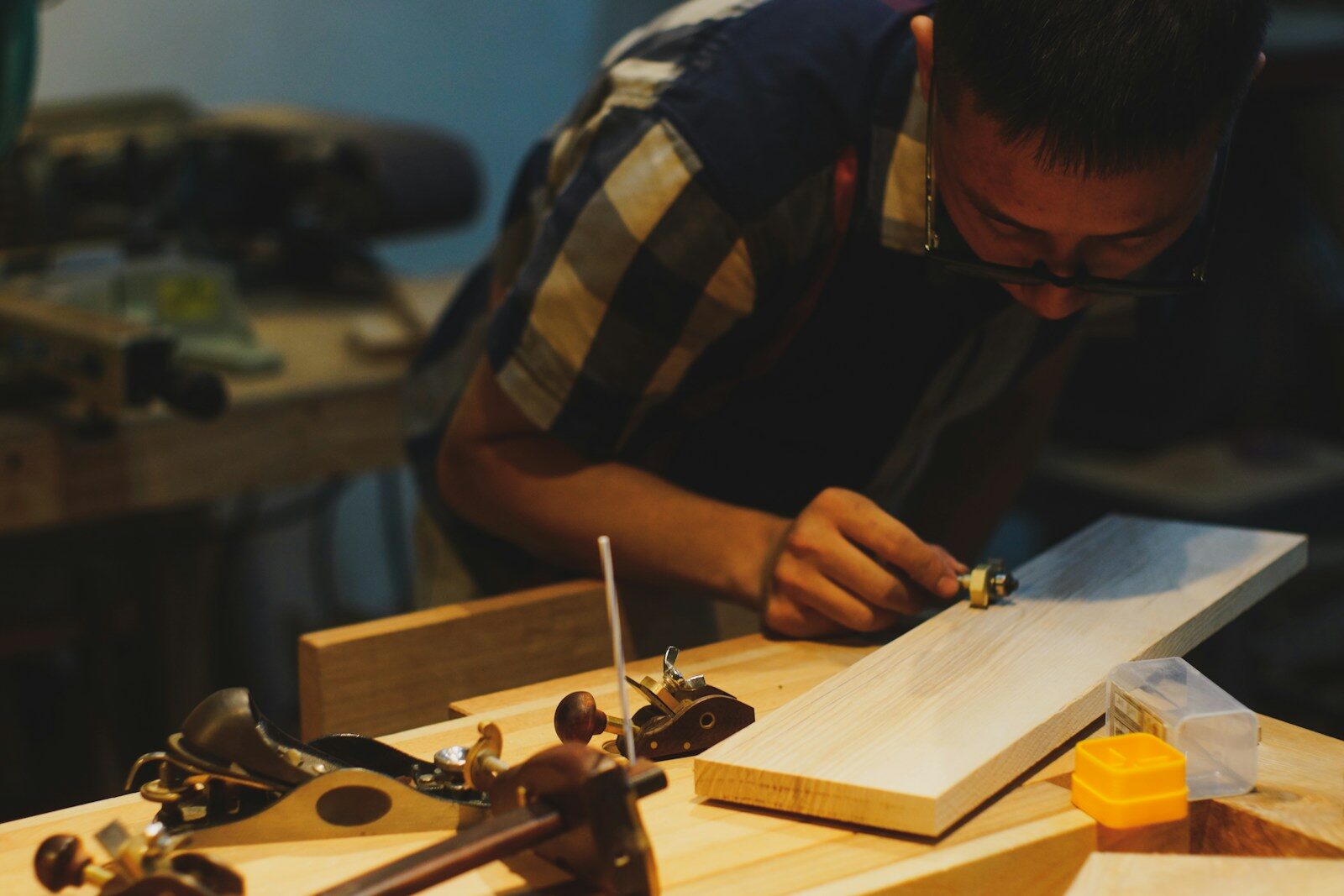
You've assembled a shelf yourself, with clumsily translated instructions and one mysterious leftover screw. It isn't perfect. One edge doesn't quite line up. And yet you look at it with a pride wildly out of proportion to how simple the object actually is. If you'd bought that exact same shelf, already assembled, you probably wouldn't have even noticed it.
Something about the simple fact that you built it makes it seem more valuable.
The discussion group with a humiliating initiation
Long before anyone studied IKEA furniture, psychologists Elliot Aronson and Judson Mills ran an experiment in 1959 that would offer one of the keys to understanding this pattern. They invited women to join a discussion group, but before getting in, some went through an easy initiation, others through a seriously uncomfortable and embarrassing one. Once inside, they all listened to the exact same discussion — deliberately boring, with no interesting content at all.
The result: the women who'd gone through the harder initiation rated the group as significantly more valuable and more interesting than those who'd gotten in easily — even though what they'd heard was identical for everyone. The effort spent getting somewhere seemed to retroactively raise the value of what was obtained.
IKEA boxes, origami, and a price 63% higher
Decades later, researchers Michael Norton, Daniel Mochon, and Dan Ariely took the idea straight into the lab, with real furniture. They had some participants assemble an IKEA storage box themselves, while others simply examined an identical, already-assembled box. Then they asked everyone how much they'd be willing to pay for the object.
Those who'd assembled their own box were willing to pay 63% more than those who'd looked at one already made.
In a related experiment, researchers had participants fold origami figures — frogs and cranes, often crooked and uneven. Those who'd folded them were willing to pay almost five times more for their own creation than an outsider would pay for the same object. What's more, when asked how much they thought someone else would pay for their origami, they still gave a high number — wrongly convinced that everyone else saw their creation as valuable as they did.
Finishing matters
Researchers also observed something important: completion amplifies the effect. When participants failed to carry the task through to the end, the extra value they placed on their own work dropped noticeably.
This makes for an interesting contrast with another phenomenon from this series: the Zeigarnik effect shows that the mind holds on more actively to what's been left unfinished. With the IKEA effect, though, it's precisely the experience of having carried something through to completion that seems to add to the value we assign it.
From a shelf assembled at home, to a house you renovated yourself
You don't need a lab to recognize the pattern.
Someone who renovated their own house, weekend after weekend, tends to ask, when selling it, a price well above what the market would offer — they see, in every painted corner, their own effort, where a buyer sees only a wall. An organization sometimes rejects a good idea coming from outside in favor of a weaker one thought up internally — not out of malice, but because the in-house idea invisibly carries the weight of the work put into it.
It happens to me most often with recipes I cook from scratch, with carefully chosen and checked ingredients, compared to an equally good meal ordered ready-made. Even though the taste is, objectively, comparable, the food I've cooked always seems a little better to me — not because it truly is, but because I put time and attention into it, and my mind confuses the effort spent with the result obtained.
Not just about objects
This is where the effect gets truly interesting, because it doesn't stop at shelves, boxes, or origami. We can overvalue, in the same way, a project we worked on late into many nights. A presentation thought through for three days. A system we invented from scratch. A business idea no one outside has confirmed yet. A piece of writing rewritten twenty times. Even a solution found in a relationship or on a team — precisely because it's our solution.
And here's the truly useful part to hold onto: sometimes it isn't hard to let go of something because that something is extraordinarily good. It's hard because we put so much of ourselves into it.
Why effort turns into affection
The explanation has to do with a basic human need called effectance — the need to produce, through our own effort, desired outcomes in the world around us. Carrying something through to completion, even something small and unimportant, gives us a feeling of competence and control. And that pleasant feeling attaches itself, without our meaning it to, to the object that produced it. We're no longer evaluating just the object. We're evaluating, along with it, the proof that we were capable of creating it.
There's a closeness here to the sunk cost fallacy, but the two aren't identical. In one case, past investment makes us keep going with something that may no longer be worth continuing. In the other, our own contribution makes us rate the result as more valuable. Sometimes, of course, the two meet: we build something, we love it because we built it, and we keep investing in it precisely because it's hard to look at it from the outside anymore.
The effect shows up in other experiments too — but with an important nuance
The IKEA effect hasn't stayed the result of just one set of experiments. A 2016 study, which replaced IKEA boxes with colorful loom bands, confirmed almost all of the original results.
The same study, though, added an important nuance: it isn't incompletion that reduces attachment the most, but destruction. Participants asked to take apart the piece they'd just finished lost almost all willingness to pay for it — far more than those who simply hadn't gotten around to finishing it. It's not just that you built something. It's that the thing you built still exists.
Next time you build something with your own hands
Next time you look with an inexplicable satisfaction at that slightly crooked shelf you assembled yourself, you don't need to convince yourself it isn't that great. Maybe, for you, it really is worth more.
Just remember that the person walking into the room sees a shelf. You see that, and the afternoon you spent building it.
And maybe that's where the whole story of the IKEA effect actually lies: the work we put into something ends up becoming part of how we see it. Others see the result. We see, without realizing it, the road that led there too.
Maybe sometimes we don't love things only for what they are, but also for the proof, kept inside them, that we were capable of bringing them to life.
If you feel you want to explore more of what is happening in your emotional life, there is a space for that.
Constellations and systems - psychogenealogy and transformation
Support the article library
If this article has been meaningful to you and you’d like to support this project, you’re welcome to make a voluntary contribution.
This contribution helps me continue writing freely and developing the resource library about body, soul, rituals, emotions, and inner transformation.