What we inherit with our name
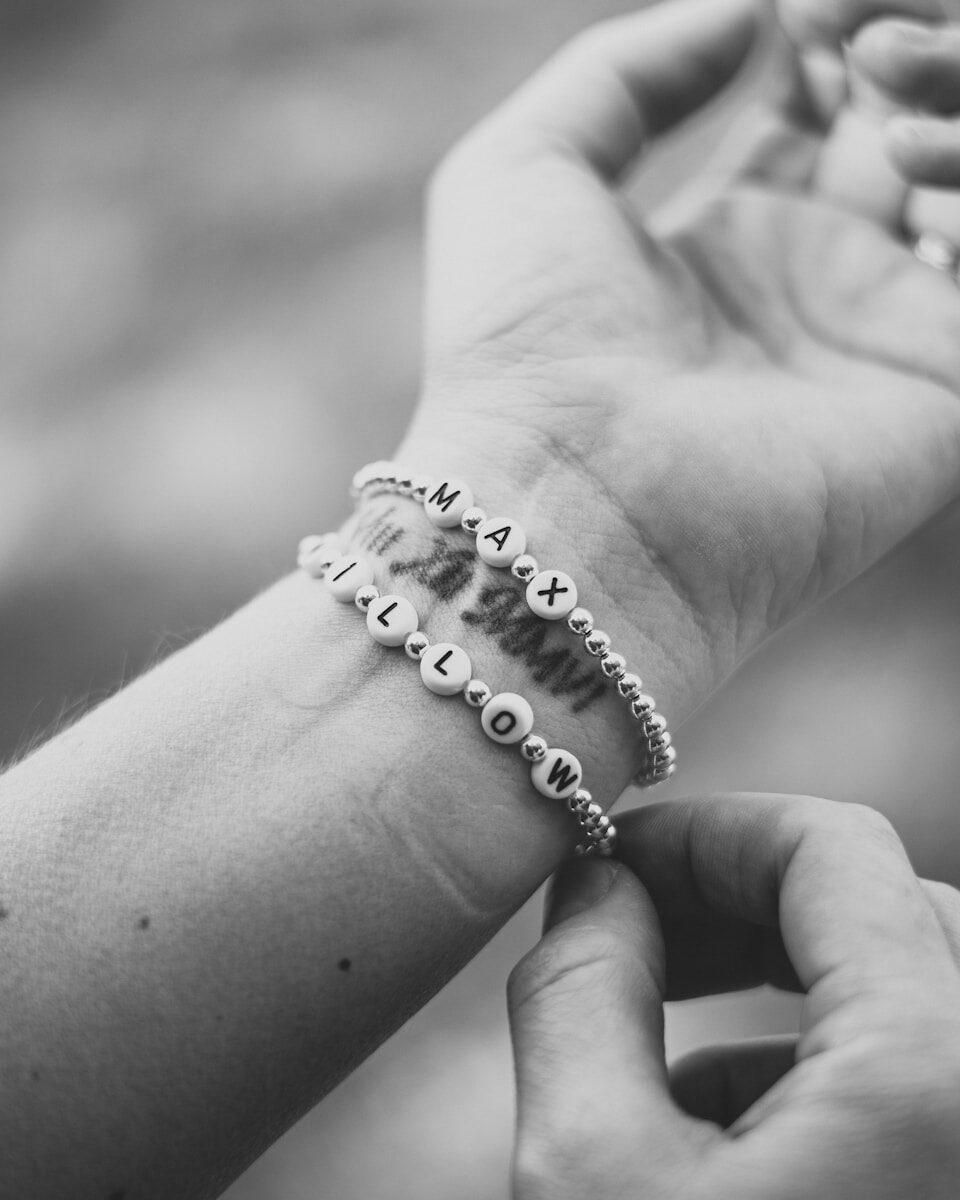
If these reflections resonated with you, you are welcome to share it further.
On first names, psychogenealogy, and the place we are given in the family story
A woman of forty sits at the table in her mother's kitchen. It isn't a special day. She's looking through some old photographs and comes across a young woman with her hair pulled back, her gaze slightly to one side, as if someone had called her from outside the frame. She asks who it is.
Her mother is quiet a moment longer than she should be. Then she says: "That's her. You were named after her."
The woman knew, somewhere, that she had been named after someone. She had never thought about it. A name is something you have, not something you were given. But in that moment, in the kitchen, something shifts. It isn't a clear emotion. It's more like a question that appears in the body before it appears in words.
Who was this woman? And what exactly did I receive from her, along with the name?
A name is not just a name
In family therapy there has long been a simple recommendation: when we build a family's genogram, we ask who each member was named after. Monica McGoldrick, one of the authors of the classic manual on genograms, writes that first names can bring family identifications to the surface, and that it is worth exploring who the source person was, what role they played in the family and, above all, what relationship the child's parents had with that person.
That last question changes everything.
Say a little girl is given the name of her mother's aunt. The raw information tells us little. But then you learn that the aunt was the admired woman of the family. The only one who left the village and went to university. She never married. She died at thirty-eight. The child's mother adored her. And the grandmother always said: "You look exactly like her."
Now the name is no longer a label. It's a door.
It doesn't mean the girl will have her aunt's fate. It means she may grow up inside a field of expectations, comparisons and stories about who she is, told before she has had a chance to say anything herself.
To carry someone's name is not to carry their destiny. But it can mean receiving a particular place in the family story. And that place comes, almost always, with an implicit sentence: you continue something of hers.
What was meant to stay alive through this name
In the psychology of grief there is a concept I find very useful here: continuing bonds. In the 1990s, Dennis Klass, Phyllis Silverman and Steven Nickman proposed an idea that changed how we understand loss: the relationship with the person who died does not have to be "closed" for grief to be healthy. It transforms, and it can continue, symbolically, in the lives of those who remain.
A name is one of the oldest vehicles of that continuity.
Almost every culture has found its own form. In the Ashkenazi Jewish tradition, a child receives the name of a deceased relative and becomes, in a phrase I've come across in the literature, a "living monument" to the family's memory. In the Sephardic tradition, by contrast, a child is often named after living grandparents, as a sign of honor. Among the Inuit, the name is considered to carry part of the person who has gone, and the child and their namesake are joined by a special relationship that has its own word. And in many Romanian villages, a name came from the grandparents or the godparents, and with it a bond that was not only affectionate but also one of obligation.
Different forms. The same gesture: not letting something go out.
And here comes the question I find most beautiful in a genogram: What was meant to stay alive through this name?
t might be love for someone. Their memory. Their status. An admired quality. But it might also be a pain that was never fully wept. An injustice. A family's hope. Or the wish, spoken to no one, that someone would come back.
We don't need to pathologise this. Sometimes the answer is simply: "I loved my grandmother very much and I wanted her name to go on." And that can be a very beautiful inheritance.
But it's worth asking. Because the answer is never the same.
Not only after whom. Also where.
Everything I've said so far rests on an assumption so familiar to us that we hardly notice it any more: that a child's name says something about the person they were named after. But if we step for a moment outside the European traditions of naming, we discover that a name can place a child in a system in entirely other ways.
In a Hindu family, usually on the eleventh or twelfth day after birth, the namakarana, the naming ceremony, takes place. The child is held in the lap, prayers are recited, and in many families the father or the father's sister whispers the name into the child's ear before it is spoken aloud. The name wasn't chosen at random. Often its first syllable was set by the position of the moon at the moment of birth, according to the nakshatra, the star under which the child came into the world. And the name itself is very often that of a deity: Lakshmi, Krishna, Ganesh. There is a beautiful idea behind that choice: every time you call your child, you speak, without meaning to, the name of God.
Here the name doesn't say după cine after whom you are. It says under which sky you were born and to whom you were entrusted.
And there is one more detail that seems relevant to anyone who grew up with two names. In Bengal, almost every child has a daak naam, he home name, the one your mother calls you by, and a bhalo naam, the "good name", the one on documents and at school. Two identities, two worlds, two ways of being called. Anyone who grew up with a diminutive at home and a full name out in the world knows exactly what I mean.
In China, things are almost the reverse of the Ashkenazi tradition. For centuries, giving a child the name of an ancestor was not a tribute but a transgression. The names of elders, of parents, grandparents, the emperor, were protected by a taboo: they were not spoken, not written, not reused. Continuity was secured differently: through a generation character, a syllable shared by all the siblings and cousins born into the same generation of the family, sometimes taken from a poem composed hundreds of years earlier for exactly that purpose. Your name doesn't say you are ca like your grandfather. It says you are the third link after him.You are placed in the chain, not identified with any one link.
And in Bali the system is simpler still and, to a European, almost disorienting: most children are named by birth order. The firstborn is Wayan, the second Made, the third Nyoman, the fourth Ketut. Then it starts again. The name says nothing about who you are. It only says which one you came.
To which we can add a custom found in many parts of Asia, from China to Thailand: the child is also given a small name, a home name, sometimes deliberately plain or even ugly, said to keep spirits or the evil eye at a distance. The name as protection, not as project.
What I find precious in all these maps is not their exoticism. It's that they show us how many ways there are to place a child in a system. After a person. After a generation. After a star. After birth order. After a deity. Under the protection of a small name.
And there is something else, which seems important to me precisely for psychogenealogy. We look for a possible continuity in the repetition of a name. In another tradition, it is precisely the non-repetition of the ancestor's name that expresses respect and genealogical order. The same gesture, opposite meanings. Which means that repetition in itself has no universal significance. The significance comes from the family and cultural system in which it appears.
The same name as your grandfather can be an honor in one family and a violation in another. A dead brother's name can be commemoration. A deity's name, a relationship with the sacred. The generation syllable, a place in the chain. Wayan or Ketut, a place among siblings. A name has no transgenerational meaning in itself. It receives one inside a family, a culture and a story.
And that changes the question we started with. It is no longer only: what do I inherit from the person whose name I carry? It becomes: what does a family do when it gives a child a name? And only then the individual question: what did my name mean in the system I was born into? Are you "the eldest"? Are you "the one who carries the name forward"? Are you "the child who came after"? Are you the one whose name your father chose, alone, against everyone?
Sometimes a name says after whom you are. Sometimes it says where you stand. But in both cases, someone decided on a place before you could choose.
Living in the light or living in the shadow
Until recently, almost everything we knew about this came from anthropology and clinical intuition. Naming traditions were studied, parents' motives, customs. Rarely did anyone ask what it is like to be the one carrying the name.
A study published in March 2026 in Family Process, by Shorer and Mahat-Shamir, did exactly that. The authors conducted in-depth interviews with fourteen adults in Israel named after relatives who had died before they were born. The sample is small and strongly anchored in one culture, so we cannot generalize. But what they found is very close to what appears intuitively in psychogenealogical work.
Participants sat along a continuum the authors called "living in the light or living in the shadow". At one end, people who described pride, honor, a sense of belonging and continuity. At the other, people who described burden, permanent comparison and a wish, carried since childhood, to change their name.
A few fragments stayed with me.
A man named after his mother's brother, who died at fifteen, said he counted the years until he himself turned fifteen. When his sixteenth birthday came, the fear disappeared. And he added, laughing: "I'm a memorial site."
Another said his grandfather couldn't say his name, because it was the name of his lost son. So he called him, every time, "Eve's Ezra". He needed to put a word between the child in front of him and the son he saw every time he looked at him.
A woman said she sometimes feels guilty for not living up to the "first" Sara. That she always feels eyes watching to see whether she measures up to the name.
And a man who, at forty, had arrived at a sentence I'd like to keep whole: "It is the person who gives meaning to the name, not the name that defines the person."
What strikes me is that the same gesture, naming a child after someone loved, produces such different experiences. It isn't the name that makes the difference. It's what comes around it: whether the source person's story was told or kept silent, whether the loss was wept or frozen, whether the child was seen as themselves or through the image of the one who was gone.
I think this is where the answer lies to the question about the "burdens" of a family line. The burden is not in the name. The name sometimes becomes the recipient of a relationship the family has with its own past. Sometimes, what could not be said, wept or laid to rest finds a place around the child who carries the name too.
The child who takes someone else's place
There is also a far heavier case, and here the literature is surprisingly clear.
In 1964, Albert and Barbara Cain described what they called the replacement child: a child conceived or psychologically invested as a replacement for a dead sibling. Not a distant relative. A lost child, from the same family, sometimes lost only shortly before.
The extreme form of this phenomenon is the necronym: the child is given the very name of the deceased brother or sister.
It seems hard to imagine today, but it was common practice. A study by Stephen Bush, published in 2019, traced the birth, marriage and death registers of England and Wales from the nineteenth century onward and showed how often the name of a child who died at a few months old was given, in full, to the next one born. The author uses a phrase I find exact: it was not only commemoration, it was a kind of symbolic reincarnation. In an age when infant mortality was enormous, it was probably also a way of surviving the pain.
But what happens to the one who carries the name?
Ines Testoni Ines Testoni and her colleagues at the University of Padua interviewed twenty-two Italian adults who carried the name of a deceased brother or sister. The study, published in 2020 in the journal Mortality, found three recurring themes: a complicated grief, left unresolved in the family, often together with a fear of death; identity difficulties tied directly to the name; and something the authors called sad gratitude. The gratitude of existing. The sadness of existing in în locul someone's place.
The literature on the replacement child goes further still. The child does not necessarily have to receive the same name. They can be placed psychologically "in the place" of someone else in the system even without the name, through the parents' gaze, through expectations, through what is not said.
That is why, in a genogram, the sequence a death, then a child born shortly afterwards, then the same name or a very similar one is always worth exploring.
Not in order to tell someone "this is your destiny". But so we can ask, with care: How much of you was seen as you? And how much was seen through the image of the one who was lost?
Loyalties we cannot see
This is where Ivan Boszormenyi-Nagy comes in, the Hungarian-American psychiatrist who laid the foundations of contextual therapy.
His concept of linvisible loyalties is, I think, far more solid theoretically than many of the popular interpretations of transgenerational transmission. The idea, greatly simplified, is that every family keeps a kind of unwritten relational ledger: who gave, who received, who sacrificed, who owes, who was wronged. Nobody reads it aloud. But everyone feels it.
And sometimes a person stays faithful to that ledger through behaviors they don't even perceive as loyalty. They feel them as their own choices.
Within this frame, a name can become a powerful gesture of loyalty. Sometimes, a parent who gives a child the name of a dead brother may be trying, symbolically, to keep a bond, to repair a loss, or to answer a debt they feel toward their family of origin. We don't know in advance which. But the child receives, without knowing it, a place in that ledger.
The authors of the Family Process s study make an observation I find very fine. Boszormenyi-Nagy was deeply influenced by Martin Buber's philosophy and his distinction between the I–Thourelationship, in which the other is met as a whole person, and the I–Itrelationship, in which the other becomes a means. Naming a child after someone can be an I–Thou gesture, a dialogue continued between the living and the departed. But it can slide into an I–It gesture when the child becomes the instrument of a debt or a pain that isn't theirs.
The same photograph. Two ways of looking.
The names of those with beautiful fates
Here, I think, psychogenealogy sometimes falls into a trap: it looks predominantly for trauma.
But names also transmit resources.
Say the godmother was independent, educated, brave, the first woman in the family to have a profession. And the parents say openly: "We named her after her because we wanted her to be like her." Then the child receives not just a name. They receive a piece of what family therapists call the family myth: the stories through which a family explains to itself who it is and what kind of people "we" are.
Freud named his sons after men he admired: Jean-Martin after Charcot, Oliver after Cromwell, Ernst after his teacher, Brücke. Not after the family's dead, but after figures who embodied something he valued. The name as wish, not as debt.
There is also a detail from research worth mentioning, with due caution. A 2021 study led by Gabriel Šaffa found that parents tend to invest more in children who carry their father's name. The result comes from self-reports, and it is hard to say how much is cause and how much effect. But it suggests something we sense: a name given with intention can sometimes draw a more attentive gaze.
So there is also legacy as resourcenot only legacy as burden.And the two do not exclude each other. The admired aunt from the first story was also the one who died at thirty-eight. Her name carries both the courage and the fear.
That is why I would like this polarity to stay together in any exploration of a name: Ce dar ai primit prin acest nume? What gift did you receive through this name? And what burden might be tied to it?
What the research doesn't say
I need to draw a line here, because it's easy to slip.
Anne Ancelin Schützenberger, who introduced the term psychogenealogy, gives central importance to the choice of first names, to repetitions, to unfinished mourning and family secrets. The Ancestor Syndrome (originally Aïe, mes aïeux!) remains one of the foundational books of this tradition. But psychogenealogy offers clinical hypotheses for exploration, not proven laws.
For example, the idea that events unconsciously repeat at the same ages or dates because of ancestral history, what Schützenberger called the "anniversary syndrome", does not have the same level of support as the well-documented fact that trauma, parenting style and family narratives can have effects from one generation to the next. The man in the Israeli study who counted the years until fifteen does not show us that a death date is transmitted. He shows us how real, in a child's body, what the family never said aloud can be.
Likewise, there is a popular literature on how our names might push us, unknowingly, toward professions or cities that sound like them. The original studies, by Brett Pelham and his colleagues, were seriously challenged when the data were reanalyzed, notably by Uri Simonsohn. Our name does not choose our job.
So I would avoid the formula: "You were given your aunt's name, therefore you were given her trauma." And I would use this one instead: "You were given your aunt's name. What else came, in your family, along with that name?"
It is more powerful precisely because it doesn't dictate the answer.
The same question, in different languages
I have met people who asked the question of their name in spiritual language: Why did I come into this particular family and receive this particular name? What does my soul have to learn here? I have no way of verifying such a frame scientifically, and I don't think that is what it is for. But I do think it can stand in dialogue with the others, without our confusing them.
A psychogenealogist would ask what identifications and loyalties are tied to this name. Someone trained in narrative psychology would ask what story about themselves the child learned from the story of their name. A grief therapist would ask whether the name is the form through which a bond with someone lost has continued. And in a family constellation, the question becomes a working one, phenomenological, not a claim about the world: Whom does this name bring into the field?
They are different questions. They don't say the same thing. But they look, from different places, at the same simple fact: someone spoke a name over a child, and the child grew up inside it.
What you can notice in yourself, right now
Say your name in your mind. Not the way you write it on forms. The way someone in your family said it when you were small.
Notice what happens in your body. Maybe nothing. Maybe a slight tightening. Maybe warmth.
Then ask yourself, without looking for the right answer: Do I know who I was named after? What do I know about that person? What was never said about them? How did the people who had known them look at me?
And if your name comes from no one, if it was chosen because it sounded beautiful or because it was fashionable, the question stays just as alive: What did my parents want when they chose it? What were they trying to bring me closer to, or further from?
Sometimes, none of this changes anything. The name stays the name.
But at other times, something that seemed yours from the beginning turns out to be a place you were put in. And only then can you choose whether you stay there, whether you move, or whether you stay, but differently.
The woman in the kitchen holds the photograph longer than she would have expected. She doesn't find out, that day, everything she would like to know. She only finds out that she has a story she didn't know, and a name that was, in fact, a sentence someone else had begun.
Perhaps that is all we can do with the names we were given. Not continue them blindly. Not refuse them. Find out what we were given. And then choose what we keep.
If you feel you want to explore more of what is happening in your emotional life, there is a space for that.
Constellations and systems - psychogenealogy and transformation
The relationship between two people – how two family systems meet
Support the article library
If this article has been meaningful to you and you’d like to support this project, you’re welcome to make a voluntary contribution.
This contribution helps me continue writing freely and developing the resource library about body, soul, rituals, emotions, and inner transformation.