Sema – when dance becomes prayer
If these reflections resonated with you, you are welcome to share it further.
Sema – the dance of the whirling dervishes and the ritual of moving inward
In many cultures, dance has never been just a form of entertainment.
Long before it reached stages or became spectacle, people danced to mark birth and death, the beginning of seasons, the harvest, war, peace, and the encounter with the sacred.
Dance was one of the oldest ways the body learned to express what words could not say. Few rituals preserve this dimension as clearly as Sema, the ceremony of the whirling dervishes in the Sufi tradition.
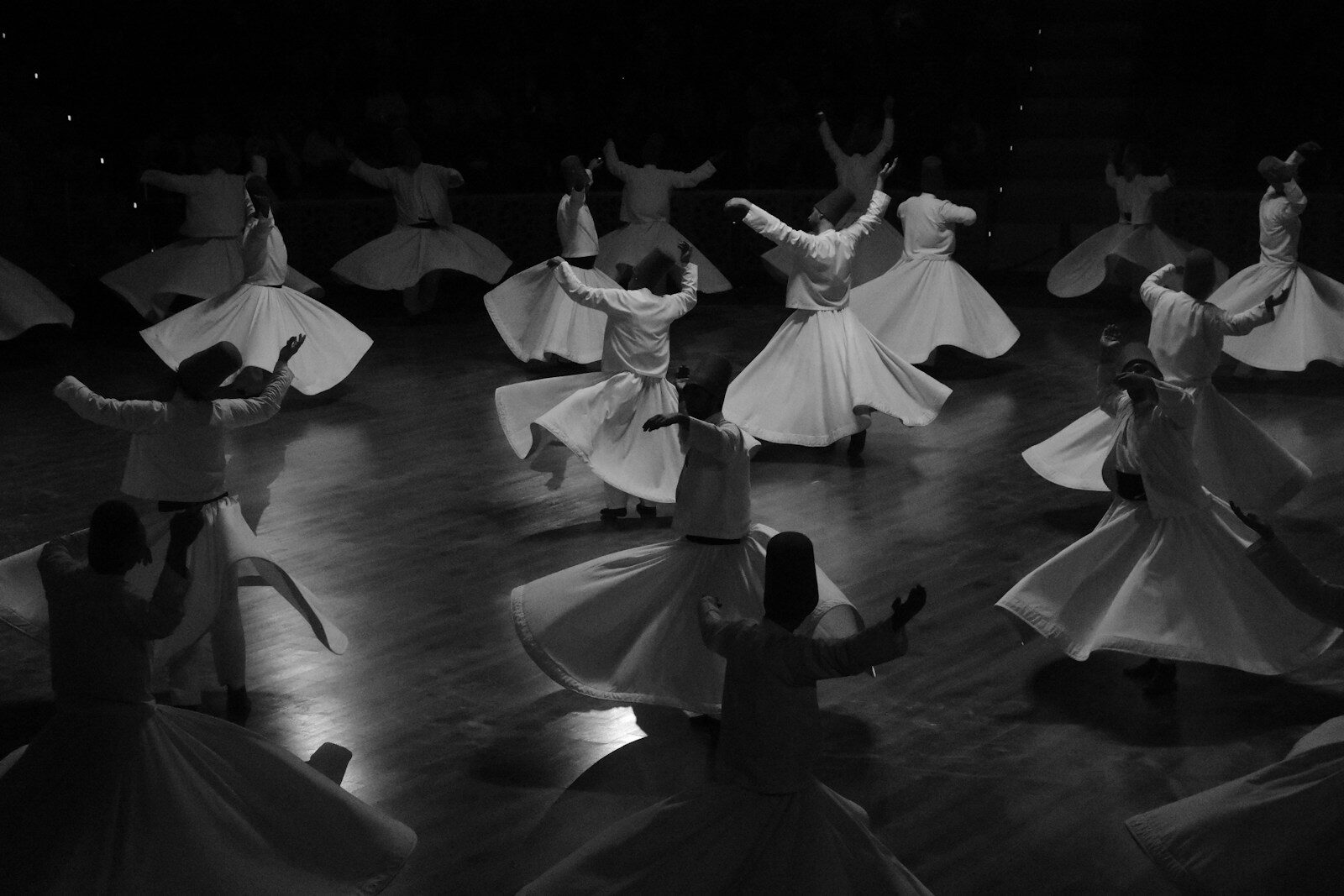
In a quiet hall, the music begins softly. You hear the sound of the ney flute.The dervishes cross their arms over their chest. Then they begin to turn. Slowly. Unhurried. In continuous circles.
For the one watching from the outside, it looks like a dance. For the one who practices it, it is a prayer in motion.
Sema has its origins in the Mevlevi Sufi order, founded in the 13th century in the city of Konya, in present‑day Turkey, by the disciples of the great poet and mystic Jalal ad-Din Rumi.
Tradition says that for Rumi, rotation became the expression of a state of love and closeness to the divine.
Since then, the Sema ceremony has been passed down from generation to generation as a spiritual practice and collective ritual. Every gesture has meaning. The black cloak symbolizes the material world. The white garment recalls inner purity. The tall hat represents the transcendence of the ego. The right arm is oriented toward the sky. The left toward the earth.
The movement expresses the idea that the human being receives and passes on. Does not keep only for oneself. At the center of the dance is not performance. But presence.
Anthropologist and historian of religions Carl W. Ernst shows that in the Sufi tradition, bodily practices are not mere symbols, but ways through which one cultivates attention, humility, and closeness to the spiritual dimension of existence.
Likewise, historian William C. Chittick observes that for Islamic mysticism, ritual movement does not seek spectacle, but the transformation of how a person relates to themselves, to others, and to God.
Perhaps this is one of the reasons why Sema continues to fascinate people around the world. Not for the speed of the rotation. Not for the beauty of the garments. But for the stillness that seems to exist right in the middle of movement.
In many spiritual traditions, one seeks the center through stillness.
Sema proposes a different path. To find the center… while moving.
Perhaps this is also one of the great paradoxes of the ritual..
The more the body spins, the more the practitioner seeks to remain stable within.
Sometimes, ritual does not mean stopping movement. Sometimes, ritual means discovering that place within you that remains unmoving, even when the world keeps turning.
👉 What helps you find your center when life seems to move too fast?
👉 Is there an activity in which your body naturally enters a state of calm and presence?
👉 If you were to turn a repeated movement into a conscious ritual, what would it be?
Support the article library
If this article has been meaningful to you and you’d like to support this project, you’re welcome to make a voluntary contribution.
This contribution helps me continue writing freely and developing the resource library about body, soul, rituals, emotions, and inner transformation.