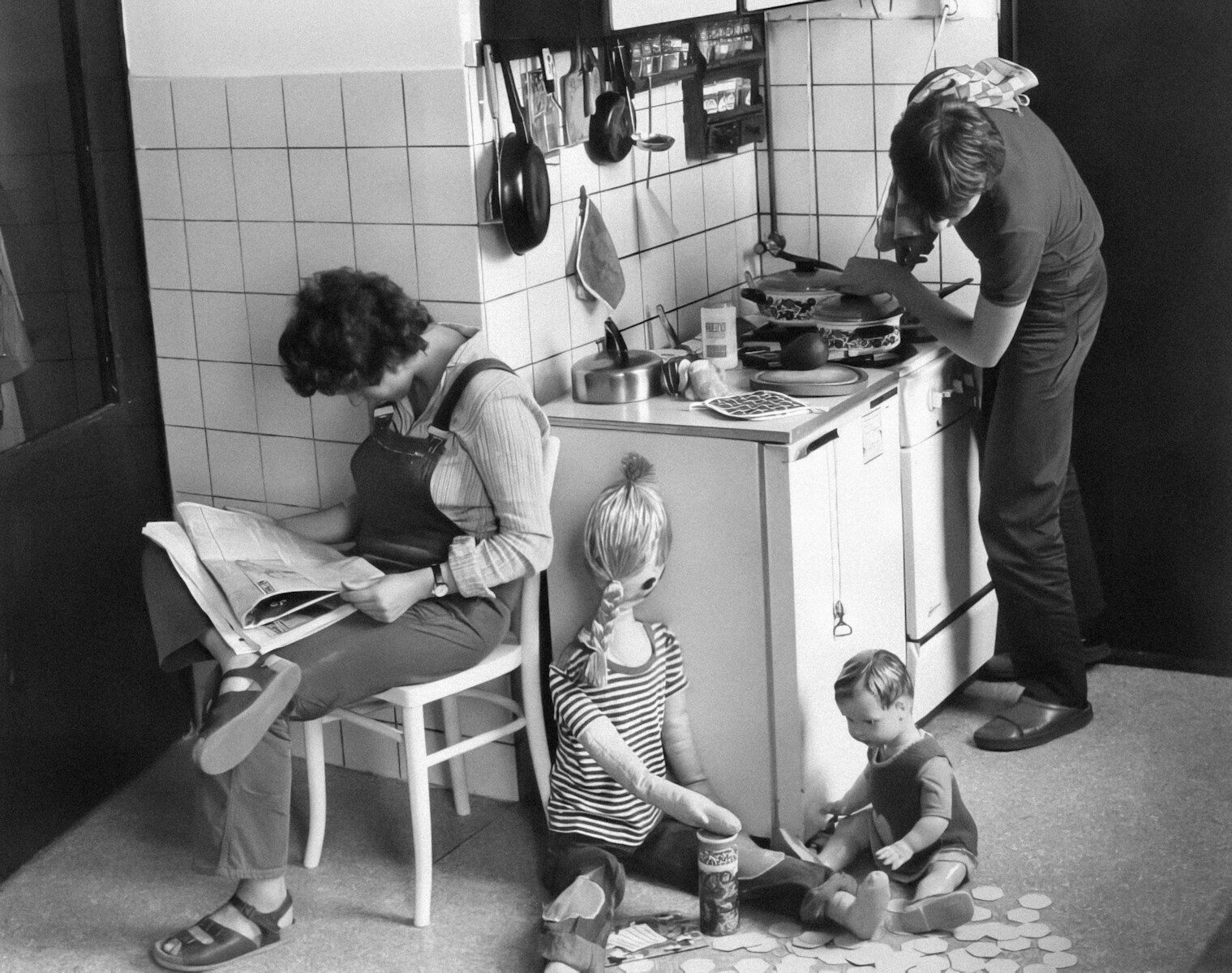
That's how it was back then
If these reflections resonated with you, you are welcome to share it further.
Or on the phrase that closes a conversation exactly where it should begin
From the series "Closer to You"
Someone is telling a story from childhood. Not necessarily something serious — sometimes just a feeling, a fragment, a scene that stayed lodged somewhere and is only now finding words. The voice hesitates a little. For a moment, there's the risk of having said something that shouldn't have been said.
And then comes the answer, almost reflexive, almost gentle: "That's how it was back then."
The conversation doesn't stop. It even continues. But something in it has closed. The person who had just started speaking senses, without quite knowing why, that there's no point going on. The phrase was said kindly, sometimes even with affection. And yet, right where more room was needed, a lid has been put in place.
The phrase sounds like an explanation. In fact, it's a door closed politely.
What the phrase actually does
"That's how it was back then" sounds like context. Like a piece of historical information, almost neutral — about an era, about norms, about a world that no longer exists. But in a real conversation, between two people, it doesn't function as information. It functions as a move, a sudden shift of ground: from one person's lived experience to a generality about the times.
Beneath the calm explanation usually sit a few unspoken things. Sometimes it's the fear of going into detail — of hearing exactly what happened, exactly what was felt. Other times it's a form of self-protection: the other person's emotion activates something hard to tolerate, so the conversation gets moved quickly onto safer ground. Occasionally it's a refusal, not necessarily conscious, to acknowledge that something was truly painful. And, almost always, underneath, there's an unspoken plea: let's not press on this any further.
It's a phrase that takes care of the adult. Not of the child who once was. When it's used to close the conversation, that is — the phrase can also, at other times, be no more than context, offered with no intention of shutting anything down.
And its deepest message, the one the person in front of you doesn't hear in words but feels in the body, is this: you're not allowed to feel what you feel.
Where the shame actually comes from
It's worth pausing here for a moment, because it's easy to confuse what hurts with what truly wounds.
Sometimes, shame doesn't come only from what happened, but from the fact that it couldn't be said back then — and can't be said, in its real form, even now.
Psychoanalyst Alice Miller took up and popularized the concept of "poisonous pedagogy" — first coined by Katharina Rutschky — to describe educational traditions in which a child's obedience was prized, while their feelings and perspective could be ignored or repressed. It's not a theory confirmed experimentally, in the strict sense — it's her perspective, built from the study of old pedagogical texts and from her own clinical practice — but it captures exactly this mechanism: it wasn't childhood itself that was forbidden, but speaking about it. A child who is told, directly or between the lines, that they're exaggerating, that they have no reason to be upset, that others had it worse, learns something very precise. Not that their experience didn't exist. That they're not allowed to put it into words.
Therapist Marsha Linehan within her biosocial model, described a related phenomenon: what she called the invalidating environment — an environment in which a child's emotional reactions are frequently dismissed, minimized, or treated as unjustified. Her model was originally formulated in the context of borderline personality disorder, not as a universal explanation for every family in which emotions went undiscussed — but the pattern it describes is recognizable much more broadly: a child raised in such an environment ends up struggling not only to express emotion, but to understand and regulate their own reactions at all.
In both perspectives, shame doesn't necessarily come from the intensity of the experience. It comes, often, from its loneliness.
When "it was normal" doesn't mean "it didn't hurt"
Something can be common without being without consequence.
Maybe many children were hit. Maybe in many homes, emotions simply weren't discussed. Maybe a great many fathers never said "I love you," and many mothers answered tears with "that's enough, you have nothing to cry about." The fact that an experience was common tells us something about an era. It doesn't tell us what it produced in each child, individually.
Here a subtle but essential distinction appears — between normalizing and invalidating.
Normalizing says: you weren't alone, other people went through something similar. Invalidating says: because others went through it too, it shouldn't have affected you.
The first pulls a person out of isolation. The second sends them right back into it.
What the adult who says the phrase is actually protecting
It's almost never cruelty. Most often, it's loyalty.
Many of those raised in periods or families where children's emotions had no room to be expressed sense, without fully realizing it, that acknowledging the pain of back then means accusing their own parents. And that feels, somewhere very deep, like a betrayal. It's easier to say "that's how it was back then" than to say "mom and dad didn't know how to listen to me" — even though the two statements can, in many cases, both be true at once, without canceling each other out.
In contextual family therapy, Ivan Boszormenyi-Nagy used the concept of "invisible loyalties" to describe relational bonds and obligations that can continue operating across generations, often without being consciously recognized. You don't need this theoretical framework for the phenomenon to be recognizable: every one of us has felt, at least once, the discomfort of naming something difficult about a parent, even when that thing was simply true.
And beyond loyalty, there's something else, simpler and less spoken about: fear of emotion itself. For some people, a room in which someone is crying or shaking with leftover anger is, quite simply, a dangerous place. Not because they don't care. But because they were never taught what to do in such a room.
What changes when you hear "me too"
And here, I think, is the most important part of this story — the part that "that's how it was back then" makes almost impossible.
When someone tells their story and receives silence, minimization, or a historical explanation in return, they're left with the impression, however unfounded, that something is wrong with them specifically. That their sensitivity is too much. That their memory weighs too heavily for something that, apparently, "was normal for everyone."
And then someone says: "I felt the same way." Or: "In my house, no one talked either." Or, simply: "I know exactly what you mean."
Psychiatrist Irvin Yalom named this phenomenon, in the context of group therapy, universality — the discovery that an experience believed to be unique, shameful, unspeakable, is in fact shared by others. He considered it one of the central mechanisms through which shame loses its power. Not because the pain suddenly becomes smaller. But because it's no longer carried alone.
Something relaxes in the body in that moment. Not because the problem has been solved. But because the story has finally found a place where it can be told in full — not summarized into "that's how it was back then," but allowed to be exactly what it was: mine, yours, so many others'.
But "me too" isn't automatically a form of meeting, either.
Sometimes "me too" means: I understand you, I'm staying here with you. Other times it means: I went through that too, and look, I'm fine — so you shouldn't be that affected either. And sometimes the other person's story simply becomes the launching point for our own, which then takes over the conversation entirely.
It isn't the similarity of experiences, by itself, that creates closeness. It's how that similarity is used — to make room for the other person, or to take their place.
Phrases that leave room, instead of the ones that close it
There's no need for long explanations, elaborate apologies, or a therapeutic speech. What's often needed is just a sentence that doesn't rush to close things off.
"We didn't know how to do it differently." "It was hard for me too, back then." "I didn't have the words for what I was feeling." "I'm sorry for what you felt." "Tell me how it was for you."
None of these rewrite the past. All of them, unlike "that's how it was back then," let it remain exactly as real as it was.
The silence itself isn't the problem
This is worth saying plainly, so it doesn't become a simplification: not every silence is harmful, and not every phrase about the past is a refusal to listen. There are moments and people for whom "that's how it was back then" really is just context, offered with no intention of shutting anything down. The difference isn't in the words — it's in what happens right after them: whether the conversation stops there, or whether it's allowed to continue.
What matters, in the end, isn't what happened back then. It's whether, today, someone is allowed to say how it was, for them.
I wrote, in an earlier piece, about the child who continues to live on in today's adult — and about how powerfully that intensity can return, even from a simple memory asked for in a few minutes. The phrase "that's how it was back then" is, perhaps, exactly the door through which that child is most often kept out of the conversation.
"That's how it was back then" seems to speak about the past. But the real question sits in the present: now, when I can finally talk about it, will you let me finish?
Support the article library
If this article has been meaningful to you and you’d like to support this project, you’re welcome to make a voluntary contribution.
This contribution helps me continue writing freely and developing the resource library about body, soul, rituals, emotions, and inner transformation.