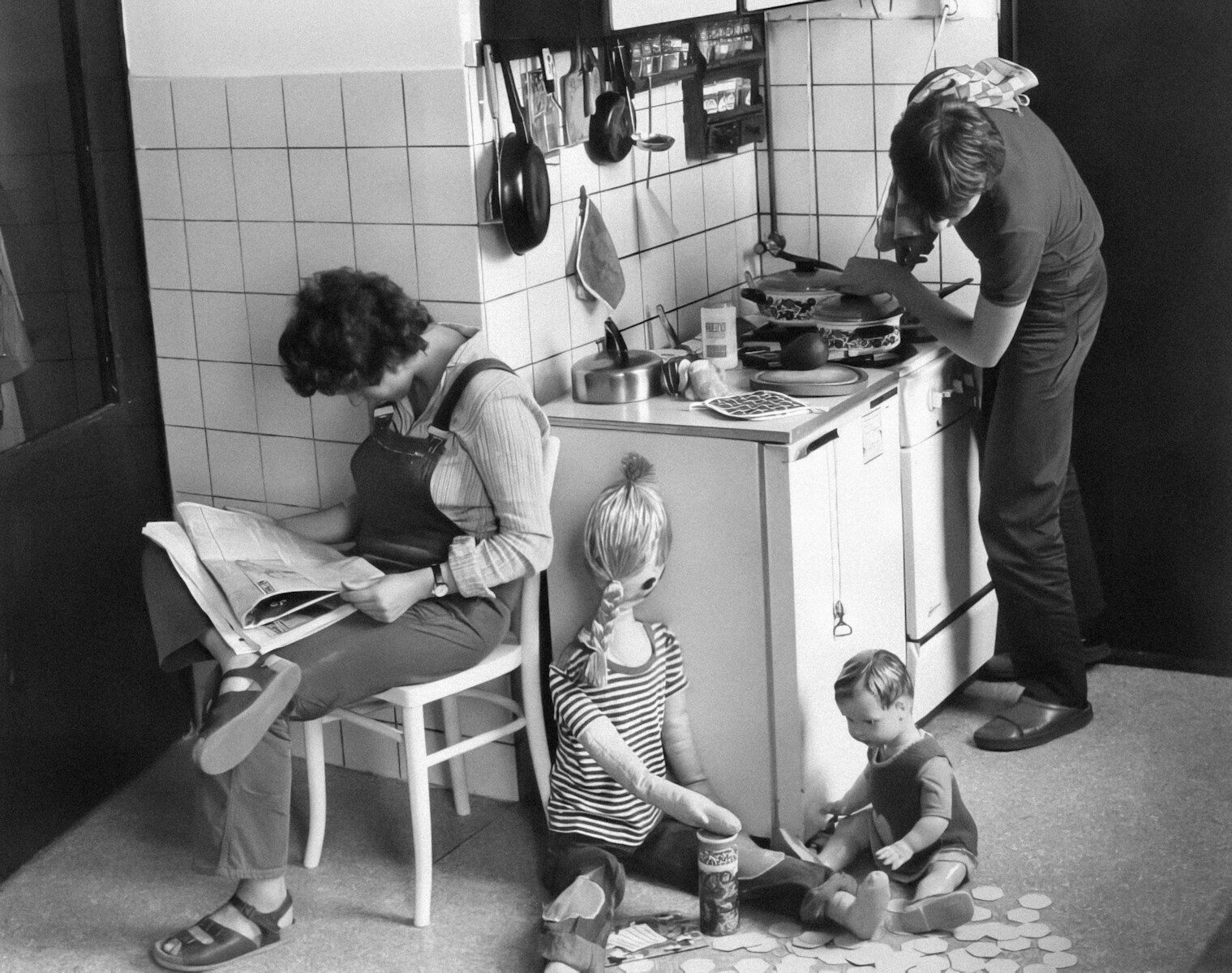
Rumination

If these reflections resonated with you, you are welcome to share it further.
Rumination – or the mind that replays, endlessly, a conversation that already ended
From the "Our Everyday Mind" series
You may have read about „L’esprit de l’escalier„ — the moment the perfect reply always arrives too late, long after the conversation has ended. Rumination is what happens when that reply never finds its rest. It doesn't stay a single line, regretted once and let go. It becomes an entire scene, replayed over and over. The same words. The same look. The same argument. As if repetition could change something about it.
It changes nothing. And yet, the mind insists.
What Susan Nolen-Hoeksema noticed
The name for this pattern belongs to American psychologist Susan Nolen-Hoeksema, who spent most of her career at Stanford, then Michigan and Yale, studying exactly this kind of thinking. In 1991, she proposed what would become the most influential theory in this field — response styles theory — distinguishing between two completely different ways people react to distress.
Some distract themselves: they get busy with something else, leave the room, redirect their attention to a concrete activity. Others stay put, mentally, returning obsessively to the same thought, the same unanswered question, the same regret. Nolen-Hoeksema called this second pattern rumination — a term borrowed, not by accident, from the world of ruminant animals, who chew the same food several times before truly digesting it.
In a study conducted after a traumatic event that affected an entire community, she showed something important: people who ruminated intensely on their own distress, instead of distracting themselves, had far more severe and prolonged depressive symptoms in the weeks that followed. It wasn't the event itself that determined how much someone would suffer later. It was the way the mind chose to relate to it.
From a psychology study, to an argument from two days ago
You don't need an event of that scale to recognize the pattern.
You may have had an intense conflict with someone important — a partner, a parent, an old friend. Something was said, or wasn't said in time. You felt you should have answered differently, pressed harder on a certain word, not gone silent at that exact moment. The conversation ended long ago. The other person, maybe, has already forgotten it.
You, however, replay it. In the shower, in the car, before falling asleep. You rewrite lines. You imagine how the other person would have reacted if you'd said things differently. You reconstruct the scene ten times, each time with a small variation, as if one of the versions might, at last, set you free.
It happens to me almost every time after a conversation where I felt wronged and couldn't say so on the spot, clearly, without hesitation. I don't think about the conversation. I relive it, every single time, along with the same knot in my stomach from back then. The difference between remembering an argument and ruminating on it is exactly this: I'm not watching the scene from outside — I'm stepping back into it.
That's why, sometimes, the body reacts each time as if the scene were happening again. The stomach tightens. The jaw clenches. The breath grows shorter. For the nervous system, the conflict isn't just remembered — it's relived.
Rumination seems to be more common in people who are deeply emotionally invested in their relationships. The more the stakes of a relationship matter to you, the harder the mind insists on finding a better ending for a scene that has, in fact, already closed.
What the mind is actually trying to solve
The explanation has nothing to do with some kind of malfunction. It has to do with an intention — even if one that fails to reach its goal.
An influential account, proposed by researcher Edward Watkins, sees rumination as a reaction to an unmet goal — not necessarily a task, as in the case of the tension described by the Zeigarnik effect, but something far more personal: the need to be understood, to repair a sense of self shaken by conflict, to restore a relationship that's been unsettled. The mind doesn't keep returning to the scene because it's masochistic. It won't leave it alone because, somewhere, it believes it can still find the missing solution.
The problem arises when the question being asked stays abstract. Why does this happen to me? What's wrong with me, that I couldn't say what I needed to? Questions like these lead nowhere — they're too broad, too loaded with self-judgment, to ever produce an answer that closes the loop. They're entirely different from a concrete question, like what, exactly, could I say next time, if a similar situation comes up again? — a much smaller question, but precise enough to actually lead somewhere, eventually.
Not every return to a thought is equally harmful
But not every return to an experience follows the same mechanism.
Later research showed that not all forms of dwelling on a thought work the same way. There's brooding — a passive, negative form, centered on self-evaluation, constantly comparing the present reality to a better state that wasn't reached — and there's reflection — a more active, more neutral form, oriented toward understanding rather than judgment. The first is closely tied to worsening depressive states. The second, used carefully, can genuinely help process a difficult experience.
The difference between them isn't about the subject, but the angle. Both can dwell on the same argument. One keeps asking, endlessly, what's wrong with me.. The other asks, once, with real curiosity, what actually happened there — and then allows itself to move on.
A single shift in perspective
There is, however, a concrete tool, tested by researcher Ethan Kross and his colleagues, that seems to interrupt the loop more effectively than any other strategy: self-distancing.
The idea is simple. When you mentally replay an argument, you usually do it from inside the scene — through your own eyes, with your own inner voice saying I, reliving the same sensations in your body as back then. Kross's research shows that if you view the same memory from a slightly withdrawn position — as a witness, not the protagonist, sometimes even using your own name instead of "I" — the stress you feel decreases, and your ability to think clearly about the conflict, to find a real resolution, increases noticeably.
It's not about denying what happened, or pretending it didn't affect you. It's simply about viewing the scene from one step back — just enough distance for the mind to finally analyze it, instead of only reliving it.
What would change, knowing this
That mentally returning to an argument isn't a sign of weakness or overreaction, but a natural mechanism that shows up precisely in people who genuinely care about that relationship.
That it isn't the conflict itself that determines how long you'll suffer because of it, but the way the mind chooses to relate to it — whether it distracts, broods passively, or truly reflects.
That the question "why does this happen to me" rarely leads anywhere. The question "what could I do differently next time" almost always does.
That, sometimes, all it takes to stop the loop is a step back — to watch the scene as a witness, not as the one reliving it again and again.
Some conversations don't end when the other person leaves. They end only when the mind stops believing it can rewrite them.
Maybe „the reply from the staircase„ was never meant to fix yesterday's conversation. Maybe it was meant to teach you something for tomorrow's — but only if, at some point, you choose to finally let it go.
If you feel you want to explore more of what is happening in your emotional life, there is a space for that.
Déjà vu – I’ve lived this moment before.
The Zeigarnik effect — or why the mind remembers what you didn't finish better
Support the article library
If this article has been meaningful to you and you’d like to support this project, you’re welcome to make a voluntary contribution.
This contribution helps me continue writing freely and developing the resource library about body, soul, rituals, emotions, and inner transformation.