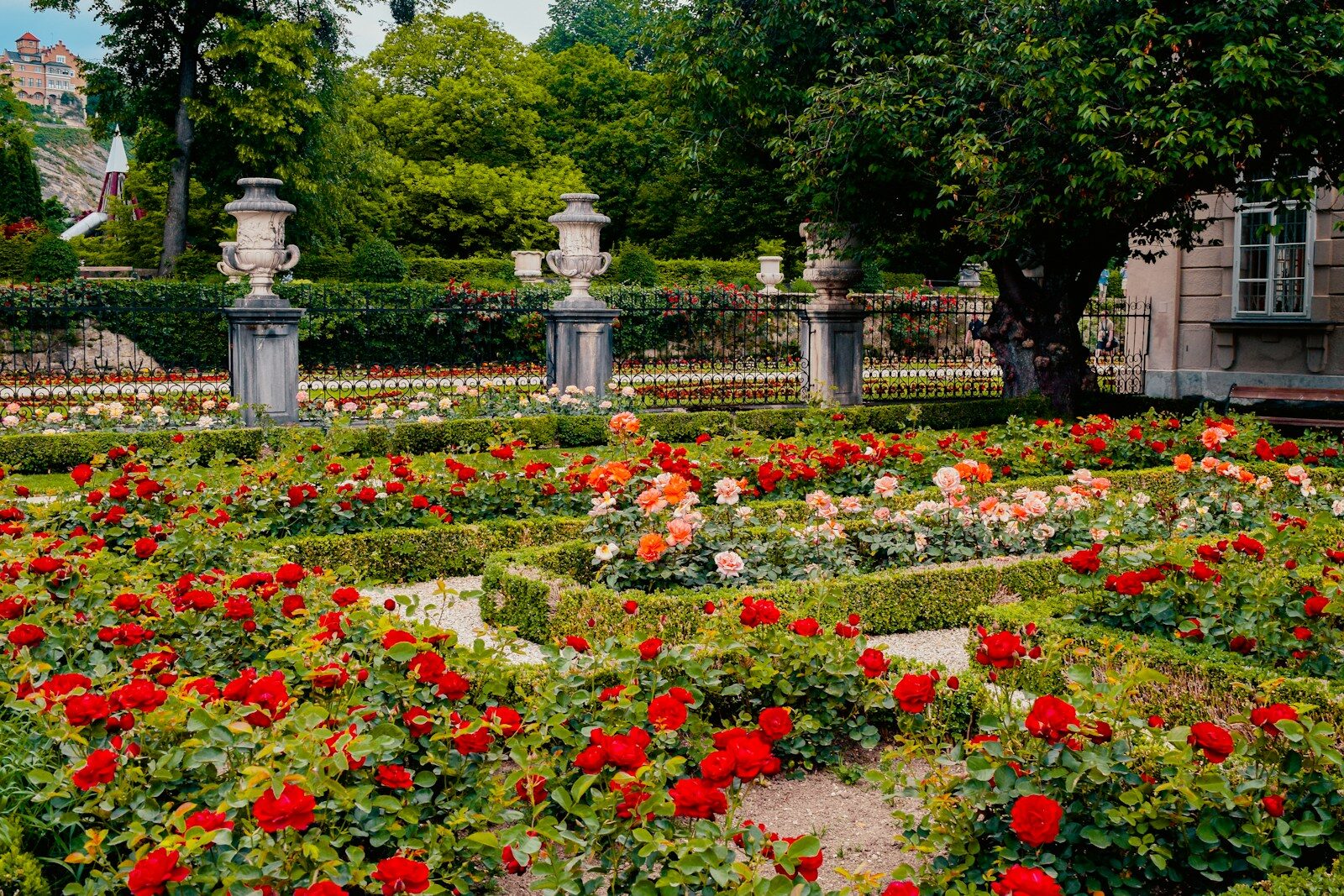
Rose Garden
If these reflections resonated with you, you are welcome to share it further.
I Beg Your Pardon (I Never Promised You A Rose Garden) – Lynn Anderson
Rose Garden — or about the songs that find us exactly when we're ready to hear them
For a few weeks I had a handful of notes stuck in my mind.
That's all. Not the lyrics. Not the title. Not the singer. Just a feeling — a shape of melody that kept returning, uncalled, in the most unexpected moments.
I'd catch myself humming it without meaning to. While walking down the street, with no music in my ears. Right before falling asleep, when the mind empties out and only the fragments the body insists on keeping are left.
I knew it existed. Somewhere, a song was calling me. But I couldn't reach it. I'd try to hum a piece of it to people, to describe a "feeling," a "kind of openness" — and no one recognized anything in what I was saying.
And then, one morning, without really searching anymore, I found it. Rose GardenA song I hadn't listened to in years — maybe even a decade. I hit play, and my body reacted before my mind did: a warmth, an opening, a tear that came without any explanation.
It wasn't nostalgia for a specific moment. I didn't remember any scene, any place, any person tied to it. It was something else — the nostalgia of an inner truth. The sense that, on some level, the body had known all along what it was looking for, even though the mind didn't have the story yet.
Only later would I understand why. That maybe the song wasn't reminding me of a particular year, a particular place, a particular person. Maybe it was simply reminding me of who I was back when I used to listen to it.
When a song becomes an inner space
There are moments when music stops being just something you listen to and becomes an inner place. A subtle touch that opens an emotional drawer you didn't know you had. "Rose Garden" did exactly that: it created a space where my body could relax, drop its guard, breathe differently. Not because the lyrics are profound. Not because the melody is dramatic. But because there's a sincerity in it that isn't trying to impress.
It's the kind of sincerity that says: I can't promise you a rose garden, but I can be here, now, with you. And sometimes that's exactly what we need to hear. Not promises, not the future, not certainties — but presence. A presence that asks for nothing and offers nothing spectacular, but that creates a space where the body can rest.
In the work of emotion, of the family system, of boundaries, of the body, there's a recurring lesson: don't ask for flowers where there's no soil.Don't ask for light where there are no roots yet. Don't ask for certainty where there's only a beginning. Songs, sometimes, remind us of exactly that — without explaining, without teaching, just by the way they settle inside us.
A short history that doesn't explain — it deepens
"Rose Garden" was written in 1967 by Joe South, but it sat in a drawer for years, like an unused emotional object. No one saw it as an important song — until Lynn Anderson heard it and felt something in it that wasn't yet visible: a truth about limits, about realism, about the way we can't promise more than we can carry through.
In 1970, when she recorded it, Anderson asked for a bright, almost cinematic orchestral arrangement — a decision that changed everything. Country music of that era was sober, traditional; "Rose Garden" opened it up toward pop, toward sensitivity, toward a kind of femininity that doesn't apologize for its own realism. The song became a global hit, won a Grammy, and entered the culture's memory not because it was cheerful, but because it said a simple truth that people felt in their bodies: I can't promise everything, but I can promise honesty.
Maybe that's why, when you find it after weeks of searching, the body reacts the way mine did. You don't just find a song. You find a truth that, in some way, you already knew.
Memories the mind doesn't keep, but the body does
We assume memory means memories — images, scenes, stories we can tell someone. But there are things the mind forgets and things the body never does.
The body remembers how to ride a bike, long after you've forgotten the first time you learned. It remembers the state a certain event brought on, long after the details of that event have completely faded. It remembers gestures and reflexes that shape us without our knowing where they came from. And it remembers, maybe more faithfully than anything else, a song — one you recognize instantly, even if you haven't heard it in years, even if you no longer remember anything about the moment you first learned it.
Sometimes you don't remember someone's face. But you remember their voice. Other times you don't remember the place. But you remember the smell of that room. Or a song. Or a particular evening light. Or the way the wind blew on a certain afternoon. The body holds on to fragments the mind never filed away as "important" — and brings them back exactly when it needs to, not when we ask it to.
That, I think, explains my weeks of searching too. I wasn't looking for a title. I was looking for access to a memory system that doesn't run on conscious command.
Why music stays when the rest of memory fades
It's no coincidence that music holds this special status. Neuroscience research shows that autobiographical musical memory is processed and sustained differently from the rest of our memories — involving brain regions that tend to be among the last affected in neurodegenerative disease.
That's why people with advanced dementia, who no longer recognize their partner or their children, can still sing, word for word, songs learned in their youth. Not because music "heals" anything. But because the bond between a song and who we are seems to hold up longer than the rest of our memories — and stays there even after everything else has already gone quiet.
It's a thought worth sitting with for a moment: that somewhere inside us there's a layer of memory built, it seems, precisely to endure. And that music may be the key to it.
A memory older than words
Maybe it's no accident that nearly every culture has used music in ritual, long before people had concepts for what they were experiencing.
Before they explained the world through ideas, people learned to feel it through rhythm. Drums, repetitive chants, psalms, mantras, lullabies weren't just carrying information. They were changing the state of the body. They brought a group together into the same breath, the same frequency, the same nervous-system state — long before language could do that as well.
Music wasn't art first. It was regulation first. A way human bodies learned to synchronize with each other, and with themselves.
Who is really looking for whom
I said, at the start, that I spent weeks searching for this song. But the more I think about it, the more I suspect things might work the other way around.
Maybe we don't search for songs. Maybe they become accessible once we become available to them.
It sounds poetic. But psychologically, it isn't absurd at all. Every day, the brain filters millions of stimuli — sounds, images, thoughts, possible memories — and lets only a small fraction through. At some point, a particular song becomes relevant. Not necessarily because it just appeared in our path. But because we've changed enough to finally be able to hear it.
Maybe I didn't find "Rose Garden" because I searched for it persistently enough. Maybe I found it because, at last, I was somewhere I could receive it.
Not a memory, but a version of you
I said, at the start, that maybe the song wasn't reminding me of a particular year, a particular place, a particular person — but of who I was back when I used to listen to it. I think that's actually the heart of this piece.
I felt, that morning, that it was a memory I simply needed to feel. But the more I sit with that idea, the more I think it might not have been a memory at all.
Maybe it was a state.
We very often mistake memory for the past — for the idea that whatever returns must be an event we lived through somewhere, at some point. But sometimes what returns isn't an event. It's a version of ourselves — a way of being in the world we once had, and that, without knowing it, we were looking for again.
These are two entirely different things. One belongs to the archive. The other belongs to identity.
I wonder, sometimes, how many songs like this still live inside us, unawakened.
How many of them aren't waiting to be searched for, but only for the moment we become still enough to hear them.
Maybe each of us carries at least one. Not as a memory we can retell. But as a version of ourselves who, somewhere, still knows the way home.
Maybe we don't need rose gardens. Maybe we just need moments when something touches us without asking anything in return. A song that reminds us to breathe. A small truth, said simply, without drama: I can't promise everything, but I can be here.
And sometimes, right there — in the small things, in gestures that promise nothing, in songs that arrive for no apparent reason — the first rose appears.
If you feel you want to explore more of what is happening in your emotional life, there is a space for that.
Share this article
Support the article library
If this article has been meaningful to you and you’d like to support this project, you’re welcome to make a voluntary contribution.
This contribution helps me continue writing freely and developing the resource library about body, soul, rituals, emotions, and inner transformation.