If these reflections resonated with you, you are welcome to share it further.
Traditional Hindu wedding – the ritual in which marriage is seen as a path, not a destination
There are weddings where the most important moment is the exchange of rings. Others where it’s the first dance.
In the Hindu tradition, one of the most important moments is surprisingly simple.
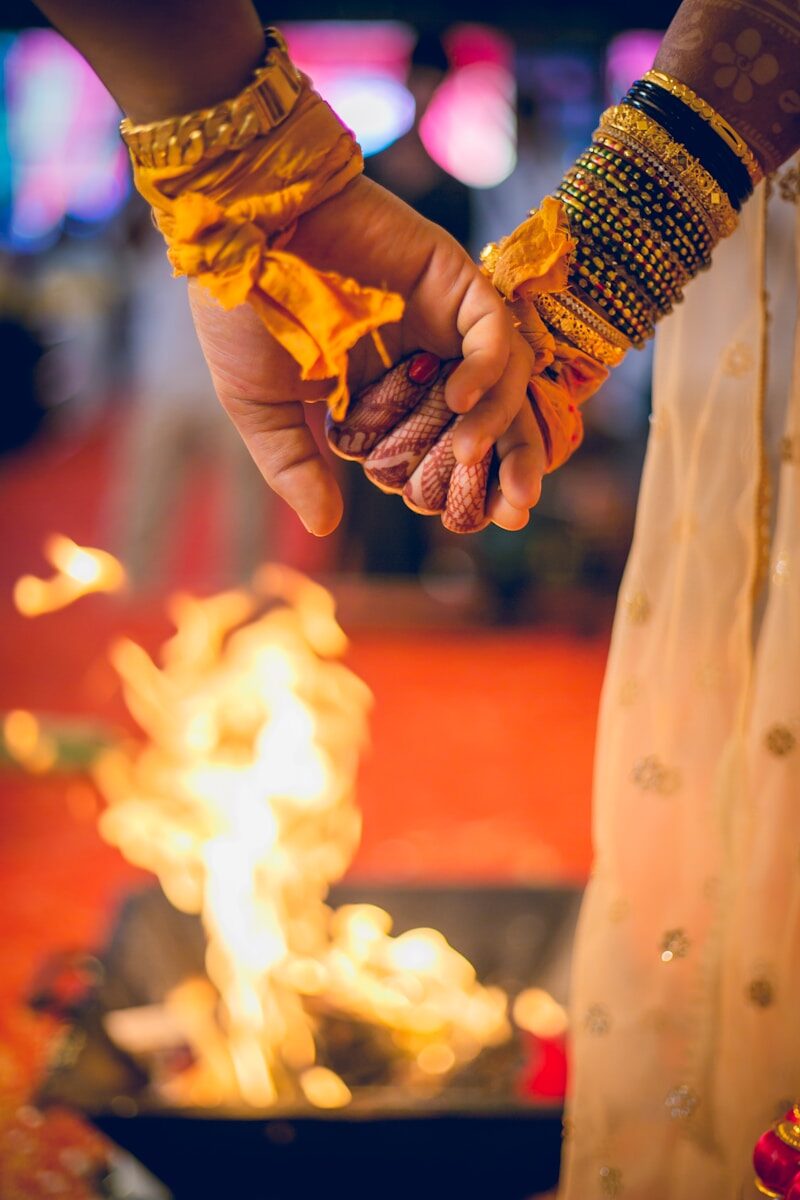
Two people walk together, slowly, around a fire. Seven steps. Seven promises. And the beginning of a journey neither of them can make alone.
In Sanskrit, the ritual is known as Saptapadi – “the seven steps” – and it represents the heart of the traditional Hindu wedding.
Although the ceremony differs depending on the region of India and each family’s tradition, this moment appears in almost all Hindu marriages and is considered the instant when the union becomes complete.
Its roots go back to the period of the Vedic texts, more than three millennia ago.
In the ancient Gṛhya Sūtra, the manuals describing the rituals of family life, marriage was seen as one of the most important saṃskāra – the rites that mark the great passages of existence.
It wasn’t just an agreement between two people. It was the beginning of a new household, new responsibilities, and a new bond between families.
At the center of the ceremony stands the sacred fire, Agni, witness to the vows.
In the Vedic tradition, fire is not just an element of nature. It is a symbol of truth, transformation, and divine presence.
That is why the promises are not made only to each other, but also before the fire, which becomes their symbolic witness. Then come the seven steps. With each step, the couple speaks a blessing or a promise: nourishment and prosperity, strength, mutual support, harmony, family, health, friendship, and fidelity.
They are not just promises about love. They are promises about everyday life. About how two people choose to walk together when life is beautiful and when it becomes difficult.
Anthropologist McKim Marriott, who studied Indian rituals and family life extensively, observed that many Hindu ceremonies do not aim only to express religious beliefs, but also to integrate the individual into a network of relationships and responsibilities.
Marriage doesn’t change only the two partners. It rearranges the entire system they belong to.
And perhaps that is why the ceremony involves so many people. Parents, grandparents, relatives, friends, priests.
In many cultures, the wedding is about the couple.
In the Hindu tradition, it is also about the community that surrounds them and becomes witness to the beginning of their shared path.
Today, many Hindu weddings are spectacular, colorful, and last several days.
But beneath the music, clothing, and celebration, the essence of the ritual has remained the same for thousands of years. Two people choose to step together. Literally.
Perhaps this is one of the most beautiful symbols of marriage.
Not the promise that the road will be easy, but the choice to keep walking beside the other.
Step by step.
Three questions for you
Is there a promise you would consider essential in a relationship, beyond the words spoken in a ceremony?
Which symbol feels more powerful to you: exchanging an object or walking together in the same direction?
If you were to turn your relationship into a simple ritual, what gesture would you repeat from time to time to remind yourselves that you are walking the same path?
❤️ Support the article library
If this article has been meaningful to you and you’d like to support this project, you’re welcome to make a voluntary contribution.
This contribution helps me continue writing freely and developing the resource library about body, soul, rituals, emotions, and inner transformation.