
The spotlight effect
If these reflections resonated with you, you are welcome to share it further.
The spotlight effect — or why you think people are watching you far more closely than they actually are
From the "Our Everyday Mind" series
You notice a stain on your shirt only after you've already left the house. Or you say something awkward in a meeting, a sentence that sounds wrong the moment it leaves your mouth. For the rest of the day, you're left with the feeling that everyone saw it, that everyone remembers, that every person in the room went home thinking about your mistake.
Most of the time, almost no one noticed a thing.
A Barry Manilow t-shirt and forty minutes of discomfort
In 2000, psychologists Thomas Gilovich, Victoria Medvec, and Kenneth Savitsky, at Cornell, designed a simple, slightly cruel experiment. They asked college students to put on a t-shirt they themselves would find embarrassing — one printed with the face of singer Barry Manilow, chosen precisely because it had no chance of impressing a room of twenty-somethings. Each student, wearing the shirt, then walked into a room where other students were already seated, busy with their own tasks.
After a few minutes, the person in the embarrassing shirt left the room and was asked to estimate how many of the people present had noticed it. The researchers then asked the people in the room, separately, whether they actually had.
The gap between the two numbers was nearly twofold. Participants were convinced they'd been noticed by almost double the number of people who actually had.
The name Gilovich and Savitsky gave it
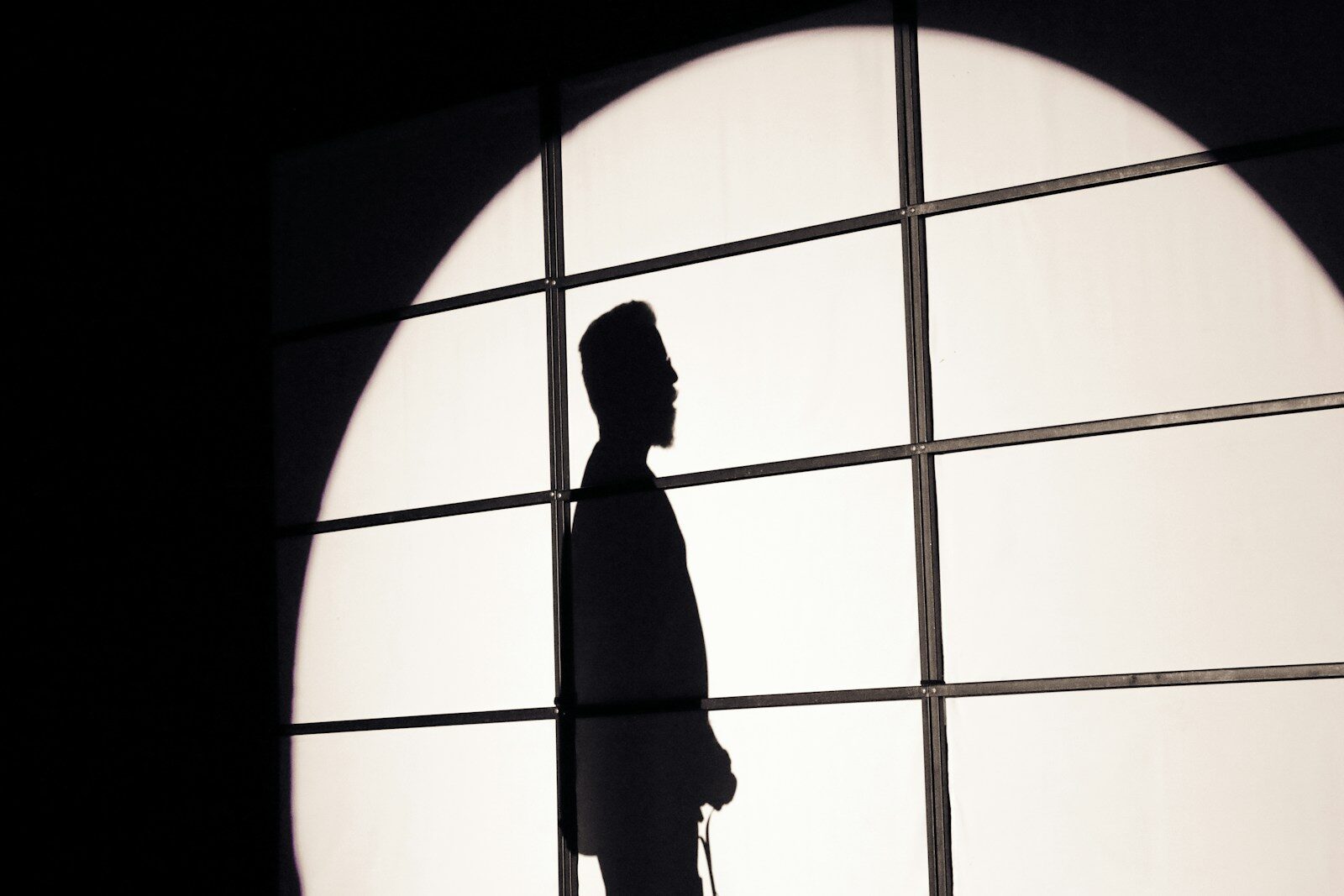
Gilovich and Savitsky named this pattern the spotlight effect — the impression that we're watched, judged, and remembered by others far more intensely than we actually are. Their explanation: each of us is, inevitably, at the center of our own experience. Every awkward gesture, every stain on our clothes, every wrongly chosen word takes up a disproportionately large share of our attention — simply because it's about us. And because of that, we assume, without realizing it, that it takes up just as much space in everyone else's mind.
Almost always, it doesn't.
The phenomenon has a close relative, called the illusion of transparency — the belief that our inner states (the nervousness in an interview, the sadness hidden behind a smile, the small, polite lie) show on our face far more clearly than they actually do. Both stem from the same quiet illusion: we live so close to our own experience that we forget others only ever see it from the outside.
From a t-shirt, to an awkward remark at Saturday's party
You don't need a Barry Manilow t-shirt to recognize the feeling.
You said something that struck you, right after, as out of place — a joke that didn't land, a story told too long, an awkward silence. You left the party convinced everyone was now talking about it. The reality, almost certainly, is different: everyone there was, at that moment, absorbed in their own conversation, their own regretted remark, or a small worry of their own from ten minutes earlier.
It happens to me too, often, after a bad photo or a day I left the house looking a little unkempt. For hours, I carry the feeling that everyone I met noticed exactly the detail I'm embarrassed about. And almost every time, when I end up talking to someone about that day, I find out no one noticed anything. I'd been the only person, in my entire day, who had looked at me that closely.
There's a natural link here to rumination: the more you mentally return to a mistake, the easier it becomes to assume others return to it just as often. In reality, most people moved on long before you did — busy, just like you, with their own inner spotlight.
Why the mind fails to correct itself
The scientific explanation involves a mechanism called anchoring and adjustment. When we estimate how visible our mistake is, we start from our own emotional state — usually very intense, because it's our own embarrassment — and try, from there, to imagine what others see. The problem is the adjustment never goes all the way. We start from how intensely we're living the moment and try to imagine the perspective of others, but we stay anchored too close to our own emotions.
In practice, we confuse how visible the mistake is to us with how visible it is to everyone else around us.
It isn't always just in your head
There's a nuance worth keeping here, so the lesson doesn't become an oversimplification.
Later research showed that the intensity of the spotlight effect depends heavily on context. There are situations with divided attention — a lecture hall, a meeting, a sports competition — where others are, in fact, busy tracking several things at once, not just you, which is exactly what makes the overestimation so strong. But there are also situations where someone's actual role is to watch you — an audience at a presentation, an examiner, an audition. There, the spotlight effect nearly disappears, because this time your assumption is correct: attention really is directed at you.
What might change if you knew
That most of the attention you think you're receiving from others is, in fact, the attention you yourself are directing at your own person.
That everyone around you has their own inner spotlight switched on, aimed at their own mistakes, their own stains, their own awkward remarks — reason enough for yours to go, most of the time, unnoticed.
That not every situation is the same: the more divided other people's attention is, the less they notice you than you think — but when you truly are the only point of focus in a room, your suspicion finally becomes justified. And that time, even a little of it, has a calming effect on this belief — one more reason not to make an important decision right after an awkward moment.
That it isn't just that others notice us less than we think. We also notice them far less than we think. Consider how many stains on someone else's shirt you remember from last week. Or how many of a colleague's awkward remarks still occupy your mind. Almost certainly, very few. And others, most likely, forget just as quickly about you.
Maybe the spotlight never really turns off. You just discover, one day, that it's pointed almost entirely at your own stage.
If you feel you want to explore more of what is happening in your emotional life, there is a space for that.
Share this article
Support the article library
If this article has been meaningful to you and you’d like to support this project, you’re welcome to make a voluntary contribution.
This contribution helps me continue writing freely and developing the resource library about body, soul, rituals, emotions, and inner transformation.