Repeating numbers: meaning, coincidence, or message?
If these reflections resonated with you, you are welcome to share it further.
Repeating numbers — or about what happens inside us when 444 shows up for the third time in one day
It happened to me, like it happens to everyone, during a stretch of time when I was making a hard decision. I'd check the time on my phone and land on 11:11, almost every time. I'd open a coffee receipt and the total would end in 444. At some point I caught myself: "again?" — with a small lift in my stomach, a feeling I can't quite name — not fear, not joy, something closer to the sense that someone is winking at me from a place I can't see.
I never asked myself whether it was true. I simply felt that it meant something. Only later did I wonder: how do I even know that? Who told me, the first time, that 444 has a meaning — and is it real, or just very well phrased?
An older story, but not quite the one you think
The list almost everyone knows today — 111 means this, 555 means that, 1111 is a "portal" — circulates widely in contemporary spiritual culture under the name "angel numbers." It sounds ancient, like wisdom passed down through generations. But it doesn't come from a single, ancient numerological system, and no research supports the idea that these sequences objectively carry a message.
What is true, though, is that the idea numbers might carry meaning isn't new at all. It's just much older than people assume — and along the way, it changed far more than anyone scrolling through a list on Instagram would guess.
Where the idea that numbers carry meaning actually comes from
About twenty-five hundred years ago, in a school in southern Italy, Pythagoras and his students looked at numbers differently than we do in a math class. For them, the order behind numbers wasn't just a tool for calculation — it was proof that the universe itself had a structure, that the world, from the movement of the planets to the harmony of a lyre string, could be understood through proportion and counting. The number didn't describe the world. It explained it.
Thousands of miles and several centuries away, other traditions arrived at a similar intuition, each on its own path. In Judaism, gematria assigned numerical values to letters and searched sacred texts for hidden correspondences. In early Christianity and in Kabbalah, certain numbers — three, seven, twelve — became carriers of theological meaning. Occult and esoteric traditions, later on, picked up the thread.
But none of them said what a post about "angel numbers" says today: that seeing 555 means a major change is coming, or that 444 shows the angels are near. The idea that numbers carry a symbolic dimension is thousands of years old. The idea that repeating sequences on your phone's clock are personalized messages is, by contrast, very recent.
How 1 through 9 became "characters"
The numerology we recognize today only took shape in the 19th and 20th centuries, in the West, at a moment when ideas attributed to the Pythagoreans were picked back up and turned into an accessible system, almost like a horoscope: each number from 1 to 9 was assigned a quality.
Someone doing their "numerology reading" around this time would read, in essence, a small portrait: one is beginning, initiative, the act of starting something on your own; two is relationship, cooperation, the balance between two forces; three is expression, communication, the joy of saying something out loud; four is structure, foundation, everything that holds something up; five is movement, change, the need not to stay still; six is responsibility and the harmony around a family; seven is introspection, the search, a question asked more deeply; eight is achievement, power, what shows from the outside; nine is closing — the last step before everything begins again with ten, which is, again, one.
This is where part of today's list actually comes from. 555 meaning change fits very naturally with the symbolism of five. 999 meaning the end of a cycle follows almost mathematically from the fact that nine is the last digit before the system starts over. But 444 meaning "the angels are near you," or 333 meaning "the presence of ascended masters," don't come from this layer. They come from a different, much more recent story.
I feel the need to pause here, because this is usually the point where someone reads the list and assumes an age that, in fact, half of it doesn't have.
Where "angel numbers" actually come from
One name essential to popularizing this list is Doreen Virtue, a widely read author in the New Age culture of the 1990s and 2000s. Her books about angels and numbers contributed enormously to the idea that 111, 222, 333, or 444 are messages sent from a spiritual realm, addressed directly to whoever sees them.
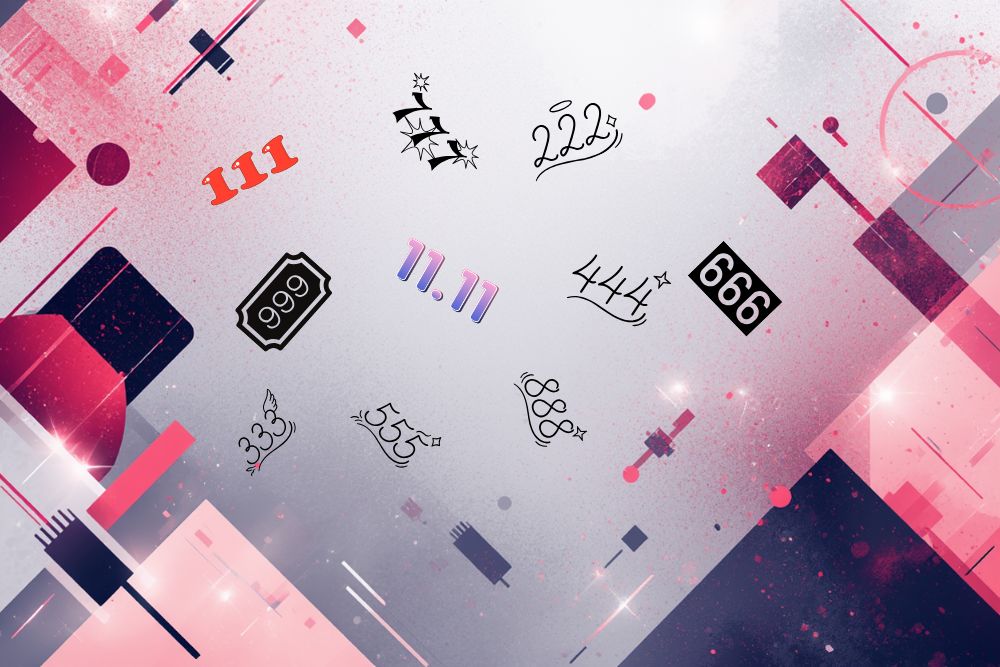
Someone opening one of these books finds a kind of dictionary: 111 means watch your thoughts, because manifestation is accelerated. 222 means trust that things are unfolding exactly as they should. 333 announces the presence of ascended masters. 444 says the angels are near. 555 arrives with an important change. 666 asks you to turn your attention from the material back to the spiritual. 777 confirms a spiritual alignment. 888 brings abundance. 999 marks the end of a cycle. And 1111 — the most charged of all — speaks of awakening, of a portal, of a moment of alignment.
Translate that into today's social-media language, and the exact same meanings turn up, word for word. Only the format changes: there it was a book with a gold cover, here it's an Instagram story. The meaning stays the same.
There's an irony in all of this worth knowing: Doreen Virtue later distanced herself from her own books. After speaking publicly about her conversion to Christianity, she began rejecting a significant part of the New Age practices she'd promoted for years — including much of what had helped build this very phenomenon. So when the internet says "444 has always meant the angels are near," that's not quite accurate. It's largely a spiritual convention that emerged in recent decades — not a tradition handed down from antiquity.
And what about 11:11?
Its story is a little different, because it isn't tied to just a list of books — it became a phenomenon on its own.
A name that comes up often in its recent history is George Barnard, associated with a movement called the „11:11 Progress Group” for whom the repeated appearance of this time was a form of spiritual communication, a sign of synchronization. From there, the idea spread quickly: synchronicity, awakening, a portal, a wish worth making in that exact moment.
The internet did the rest. "Make a wish, it's 11:11" became almost a secular ritual, as widespread as the superstition about a falling star. But the very specific claim — "11:11 is a divine portal opening" — is recent New Age vocabulary rather than an ancient numerological doctrine, even though, at first hearing, it sounds like the exact opposite.
But what about Jung?
This is where I think things get genuinely interesting — more interesting, maybe, than the whole list above.
Carl Gustav Jung didn't invent "angel numbers." He never said, anywhere, that 444 means angels or that 888 brings money. But he did carefully name a related phenomenon: synchronicity — the moments when a coincidence feels so charged with meaning that we stay convinced it can't be random, even though no proven causal link exists between the events.
The difference between the two perspectives is bigger than it first appears. In one case, the question is: "did the universe send me 444?" — which already assumes an external, universal code speaking to all of us the same way. In the other, the question shifts: "why did 444 become meaningful to me, exactly now?" — which turns us, instead of toward an outside messenger, toward the relationship between the event, our psyche, and the meaning a coincidence begins to take on.
The first question asks for an answer from somewhere outside us. The second asks us to also look inward — without that necessarily canceling the meaning we give the experience.
What the research actually says
There's no scientific evidence that sequences like 111, 222, or 444 appear in order to deliver spiritual messages, or that they predict a change, an abundance, or the end of a cycle. That needs to be said plainly.
What there is, instead, is a great deal of research on why we notice patterns like these — and here things become, I think, just as fascinating as the spiritual side, only from a different angle.
The brain is extraordinarily good at detecting regularities. Once a certain number becomes important to us — because we read about it somewhere, because a friend mentioned it, because we googled it at 2 a.m. — our attention starts picking it out far more easily from everything around us. The phenomenon has a name: the frequency illusion, also known as the Baader–Meinhof effect.You learn about something, and suddenly it seems to show up everywhere. Not necessarily because its real frequency changed. But because our attention did.
On top of that comes confirmation bias: if you've learned that 555 means change, and you see 555 right before something important happens, you remember that coincidence very clearly. The thirty other times you saw 555 and absolutely nothing happened are much easier to forget — because they didn't confirm anything, so they had no reason to stay.
What still holds true in everything you feel
I want to pause here for a moment, because the psychological explanation risks sounding like a denial — and that's not what I mean to say.
Think about the last time you saw, without looking for it, a number that gave your chest a small squeeze. Maybe it was 11:11 on the nightstand clock, on a night when you were wondering if you'd made the right decision. Maybe it was 444 on a receipt, on the exact day you needed a sign that you were heading the right way. Your body reacted before your mind analyzed anything — a small catch of the breath, a feeling of "here, exactly now." That moment was real. The emotion in it was real.
The fact that psychology can explain the mechanism by which we came to notice that exact number, at that exact moment, doesn't decide, in your place, what symbolic value you assign to the experience. It explains why certain patterns become visible to our attention. But explaining a mechanism isn't the same as fully explaining an experience.
The fact that selective attention exists doesn't prove that every meaningful coincidence is produced exclusively by it. And, at the same time, the fact that a coincidence feels extraordinary doesn't prove it was sent by an outside intelligence. Science can tell us why we notice repeating numbers. History can tell us where their interpretations come from. Neither one can definitively settle what such an experience means for the person living through it.
Three ways of looking at the same phenomenon
Looking at this whole story together, I see, I think, three different layers, not just one. The numbers 1 through 9 received, over the centuries, symbolic meanings in traditions very different from one another. The "angel numbers" list we see today is, for the most part, a recent spiritual construction, heavily popularized over the last three or four decades. And the mechanisms by which we notice and retain exactly these sequences have a well-documented explanation, rooted in how our attention works.
Jung's synchronicity doesn't fit neatly into any one of these three layers, and it doesn't contradict them either. It doesn't prove that a number was "sent." But it takes seriously the fact that a coincidence can become extraordinarily important to the person living it — and that this importance deserves a question, not a quick label.
That's why, if you check ten different spiritual authors, you'll almost certainly find ten slightly different lists — especially for 222, 333, 666, or 1111. There's no official, universally accepted table, no matter how often the way it circulates online suggests otherwise. What exists instead is a fairly recent cultural phenomenon, built on top of a much older symbolic layer, and partly explained by a well-documented psychological mechanism.
I'll come back, at the end, to that evening with 11:11 on my phone and 444 on the coffee receipt. If it happened again, my body would still catch for a moment. I'd still feel that small lift in my stomach. And despite everything I now know about selective attention, confirmation bias, and the frequency illusion, some part of me would still wonder: why exactly now?
I don't know if the number would be a message. But I don't feel the need to decide that it isn't.
Maybe that's the most interesting part of this whole story.
We can find out who popularized the meaning of 444. We can trace the history of numerology all the way back to the Pythagoreans. We can understand very well the mechanisms by which the brain notices a pattern once it's become important to us.
And after all of that, the experience remains.
That very personal moment when a number shows up exactly while you're thinking about something, while you're waiting for an answer, while you're standing at some threshold in your life — and something happens inside you.
Maybe it's our attention recognizing a pattern. Maybe it's what Jung would have called a meaningful coincidence. Maybe, for someone, it's a sign.
I don't think an article can — or should — decide that on behalf of the person living the experience. Maybe the only thing we can do is stay a little curious. Notice when these numbers show up, what's happening in our lives in those moments, what questions we're carrying, and what meaning they take on for us.
And only then ask ourselves: what does it mean, for me?
Share this article
Support the article library
If this article has been meaningful to you and you’d like to support this project, you’re welcome to make a voluntary contribution.
This contribution helps me continue writing freely and developing the resource library about body, soul, rituals, emotions, and inner transformation.