Famadihana – when the ancestors are brought back into the midst of the family
If these reflections resonated with you, you are welcome to share it further.
In Madagascar there is a saying that anthropologists keep quoting: houses are built of wood, tombs of stone. The house is for one human lifetime. The tomb is for ever.
In the highlands at the center of the island, the family tomb is often the most solid building in the landscape – better kept than the house, more costly, more important. And once every few years, its stone door is opened. The ancestors are carried out, wrapped in new shrouds, borne on shoulders, rocked to the rhythm of music. They are spoken to. They are told who has been born, who has married, who has moved to the city.
Then they are laid back in place, and the door is closed until the next time.
Famadihana – the "turning" of the ancestors
The word famadihana comes from the Malagasy mamadika, "to turn", and from there comes the translation that has travelled around the world: the turning of the bonesIt is an outsider's translation. Those who practise the ritual speak rather of a reunion, a family celebration, a duty towards the razana, the ancestors.
Famadihana belongs first of all to the Merina and Betsileo peoples of the Central Highlands, not to Madagascar as a whole – the island is home to dozens of groups, with very different funeral customs. The ritual usually takes place in the cool, dry season, between July and September, at intervals of several years – five or seven are often mentioned, but the rhythm varies from one family to another. The date is not chosen at random: many families consult a mpanandro, a traditional astrologer who knows the favorable days.
Preparations take months, sometimes years. A famadihana means hundreds of guests, a sacrificed zebu, food, musicians, drink and, above all, new silk shrouds called lamba mena – "red cloth", although they are rarely red any more. Many families save for years for this moment. It is not a matter of budget alone: the fact that people choose to spend so much on the dead says something about the place the dead hold among the living.
The day the tomb is opened
The day begins with music. Relatives arrive from every corner of the country, sometimes from abroad. The tomb is opened, and the bodies – or what remains of them – are carried out on mats by members of the family.
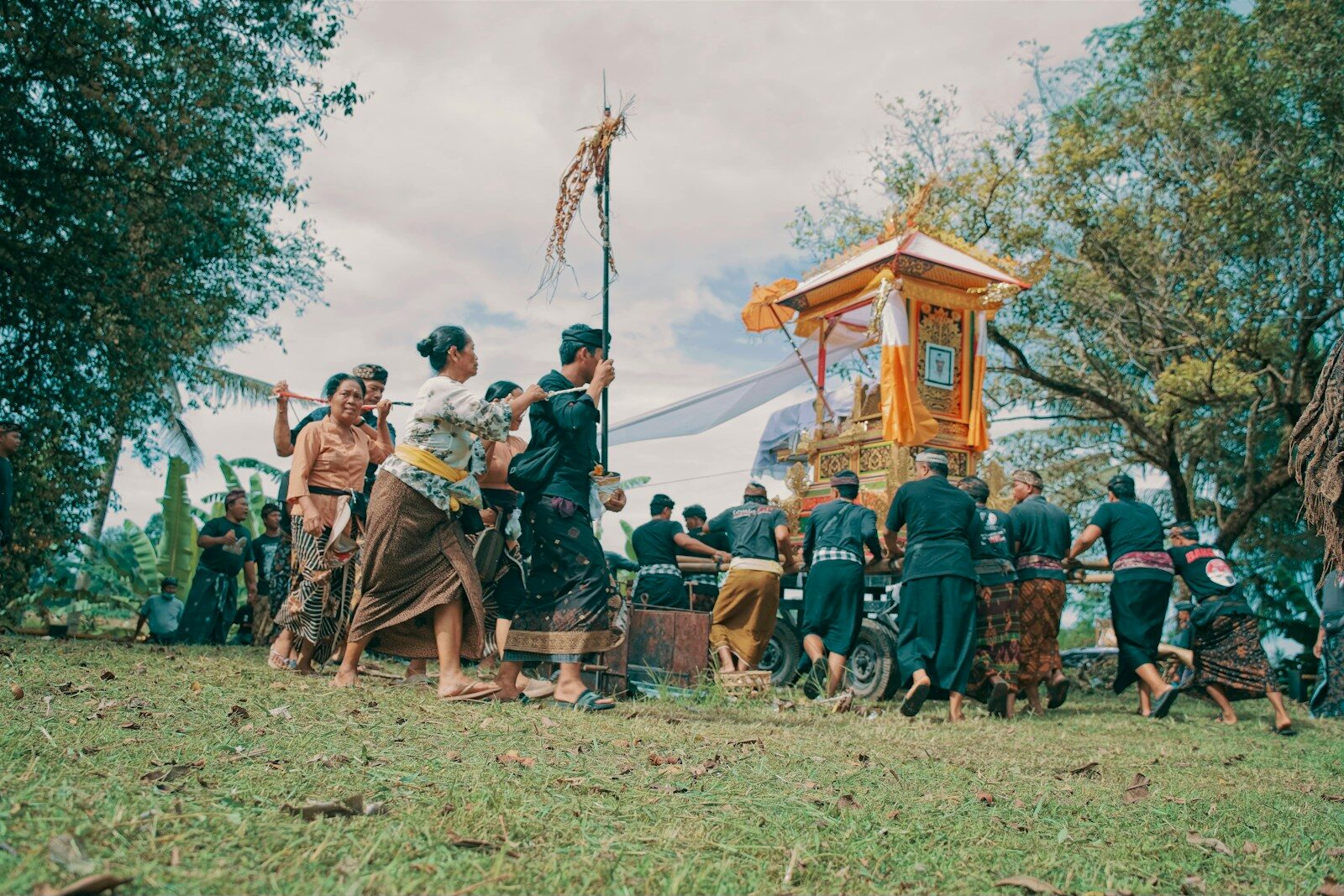
Then comes the part that astonishes outsiders: the ancestors are held. Relatives sit with them in their laps, call them by name, tell them the family news, introduce them to the children born in the meantime. Then they are rewrapped in the new shrouds and carried on shoulders around the tomb, while the band plays and people dance.
It is not an atmosphere of mourning. It is closer to the atmosphere of a wedding. People laugh, drink, joke. Sadness is not absent, but the tone of the day is one of joy: the ancestors come out into the light, and the family receives them festively.
At the end, the bodies are laid back in the tomb and the door is sealed. Maurice Bloch also describes an unsettling detail: the mats on which the ancestors lay are fought over by women who wish to have children, as if touching them could pass fertility from the dead to those not yet born.
What an anthropologist sees: the dead who become "the ancestors"
The anthropologist Maurice Bloch, who lived and did research among the Merina from the 1960s onwards, noticed something that complicates the romantic image of the ritual. In Placing the Dead (1971), he shows that the tomb is not only a burial place but the heart of a kin group's identity. A person belongs to the land of their ancestors through the tomb in which they will be laid. To be buried "at home" is to remain part of the family, however far away you may have lived.
But Bloch also observes something subtler. With each famadihana, the bones mingle, the shrouds are layered one over another, and the individual slowly dissolves into the collective. The dead do not remain "grandfather" or "aunt" for ever. Gradually they become razana – the ancestors, in the plural, without outline. The ritual does not only preserve individual memory; it transforms it into belonging.
Perhaps this reveals one of the ritual's deepest functions: not only to keep the dead close, but gradually to turn a biography into a genealogy. At first there is a person with a face, a voice and a story. Over the generations, less of the individual remains and more of their place in the family. Personal memory becomes the memory of a lineage.
David Graeber, who also worked in Madagascar, added an important nuance in his 1995 study of famadihana. The ancestors are not only loved. They are also feared. They impose rules, prohibitions (fady), obligations. Sometimes, people say, dissatisfied ancestors appear in dreams and ask for a new shroud. The relationship with them is affectionate, but also heavy: a debt that is never fully paid.
This ambivalence makes the ritual truer, not less beautiful. A family's inheritance is at once a support and a burden.
And perhaps famadihana gathers the living as much as it brings back the dead. For a few days, relatives scattered across cities or living abroad return to the same tomb. Children learn who the people in the shrouds are. Names are spoken. Bonds are renewed. The ritual does not only sustain the relationship with the ancestors; it periodically rebuilds the family that is still alive.
A ritual that changes
Famadihana is not a relic frozen in time. Many churches in Madagascar have reached a compromise with it, treating it as a cultural custom. Some evangelical groups reject it. Younger generations who have moved to the city increasingly question the costs. In 2017, during a plague epidemic, the authorities restricted the exhumation of those who had died of the disease, and the debate also became one of public health.
Living rituals are constantly negotiated. That does not make them less authentic – it makes them alive.
An old idea: the second burial
To many readers, famadihana may seem exotic. And yet it is not so far from Europe.
As early as 1907, the French sociologist Robert Hertz wrote about "double obsequies": in many cultures, death does not end on the day of burial. There is a second moment, sometimes years later, when the bones are exhumed, cleaned and laid to rest for good. Only then does the dead person complete their passage, and only then do the living complete their mourning.
In the Orthodox world, too, there is a custom of exhuming the bones some years after burial. In Greece it is widespread; in Romania it survives only locally, in certain villages and monasteries, in forms that differ from place to place. Where it is kept, the bones are taken out, often washed with wine, wrapped in clean cloth and laid to rest again, with a church service and a memorial meal. The tone is different – more sober, quieter than the Malagasy music and dancing. But the gesture is related: the departed are touched again, cared for, laid back in place. They are not simply left to the earth.
If Día de los Muertos set a plate for the departed, and Obon lit fires to show them the way home, famadihana does something even more direct. It does not wait for the ancestors. It brings them out into the light and takes them into its arms.
What remains of a ritual like this
In systemic work and in family constellations we meet an idea that, in an entirely different language, may resonate with what we see here: every member of the family has a place, including those who have died, those who have been forgotten, and those who are no longer spoken about. In famadihana, the departed are periodically brought back into the midst of the family. For one day, the distance between generations seems to shrink: the living touch them, name them and include them once more in the family's story.
But Bloch and Graeber remind us not to simplify. The ritual does not only say "we keep you with your name". It also says "you belong to us, just as we belong to you" – with everything that implies: loyalty, obligation, inherited rules. To belong to a system is to be given a place. But sometimes it also means carrying something you did not choose.
Perhaps this is the ritual's subtlest lesson: the bond with the ancestors is not a gesture made once and for all, but a relationship that has to be renewed. The shrouds are changed. The names are spoken again. New children are introduced. And each generation decides, little by little, what it carries forward and what it lets rest.
Perhaps the ancestors ask us neither to forget them nor to carry them unchanged. They ask us, from time to time, to wrap them in a new cloth.
Three questions for you
If you could tell your ancestors what has happened in the family since they left, what would you tell them first?
What in your family's inheritance feels like a support – and what feels like a debt you did not choose?
What "new cloth" would you like to wrap around your family's story – what would you like to see differently, without forgetting?
Support the article library
If this article has been meaningful to you and you’d like to support this project, you’re welcome to make a voluntary contribution.
This contribution helps me continue writing freely and developing the resource library about body, soul, rituals, emotions, and inner transformation.