Loy Krathong – when light is set adrift
If these reflections resonated with you, you are welcome to share it further.
Loy Krathong – the festival of floating lights and the ritual of letting go in Thailand
On a November evening, the rivers, lakes, and canals of Thailand begin to fill with light.
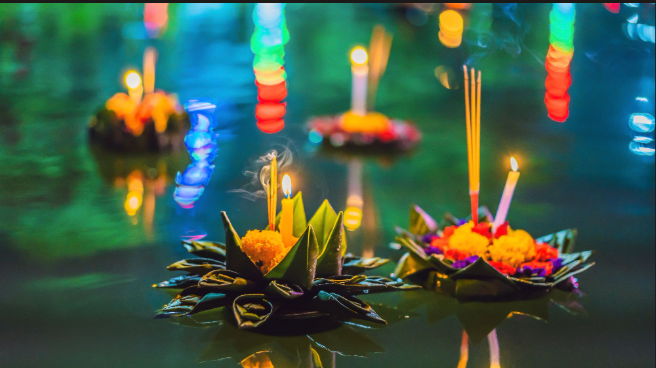
Thousands of candles drift slowly across the water. Some carry flowers. Others carry incense. Many carry wishes, prayers, or things people have chosen to leave behind.
This is Loy Krathong, one of the most beautiful and symbolic collective rituals in Southeast Asia.
Its name can be roughly translated as “to float a basket.”
Participants create small ceremonial vessels called krathongtraditionally made from banana leaves, flowers, and candles. They then place them on the water and watch them drift away in silence.
The festival takes place each year on the night of the full moon of the twelfth month of the traditional Thai lunar calendar, usually in November.
Its origins are not entirely certain, but most historians connect it to ancient agricultural traditions and water-related practices from the Kingdom of Sukhothai, one of the earliest major kingdoms of Thailand.
Water has always held profound importance for the communities of this region. It provided food, transportation, and the conditions necessary for cultivating rice.
Perhaps this is why Loy Krathong is often described as an act of gratitude toward water itself.
People light candles, offer flowers, set intentions, and then allow the water to carry away what they no longer need to hold on to.
From the outside, it may appear to be simply a spectacular festival. Yet for many participants it is also a deeply personal ritual: a moment of reflection, a moment of closure, a moment of release.
Anthropologist Stanley Jeyaraja Tambiah observed that in many Asian traditions, water is not merely a natural element but also a symbol of transformation and of the continuous flow connecting people, nature, and the spiritual world.
Similarly, anthropologist Charles F. Keyes wrote about the way Thai festivals create spaces where personal experience and collective identity meet.
Perhaps that is why Loy Krathong continues to move so many people. It is not only about what is placed upon the water. It is also about what is allowed to leave: a disappointment, a fear, a regret, a chapter that has come to an end.
Many cultures have rituals for beginnings. Loy Krathong speaks about something different: the importance of endings, the ability to give thanks for what has been and to allow the past to continue its journey downstream.
Perhaps this is why the image of thousands of floating lights continues to fascinate people around the world.
Each light seems small. Yet each one carries a story. And perhaps the ritual truly begins the moment we choose to stop holding on to it.
👉 If you could place a thought, a fear, or a story into a small floating vessel, what would you choose to let go of?
👉 Is there something you feel grateful for before moving forward into the next chapter?
👉 What part of your life today needs more flow and less resistance?
Support the article library
If this article has been meaningful to you and you’d like to support this project, you’re welcome to make a voluntary contribution.
This contribution helps me continue writing freely and developing the resource library about body, soul, rituals, emotions, and inner transformation.