Panchakroshi Yatra – the sacred circle of walking, time, and transformation
If these reflections resonated with you, you are welcome to share it further.
In many spiritual traditions, transformation does not happen in one spectacular moment. It appears through a slow, repetitive, steady process.
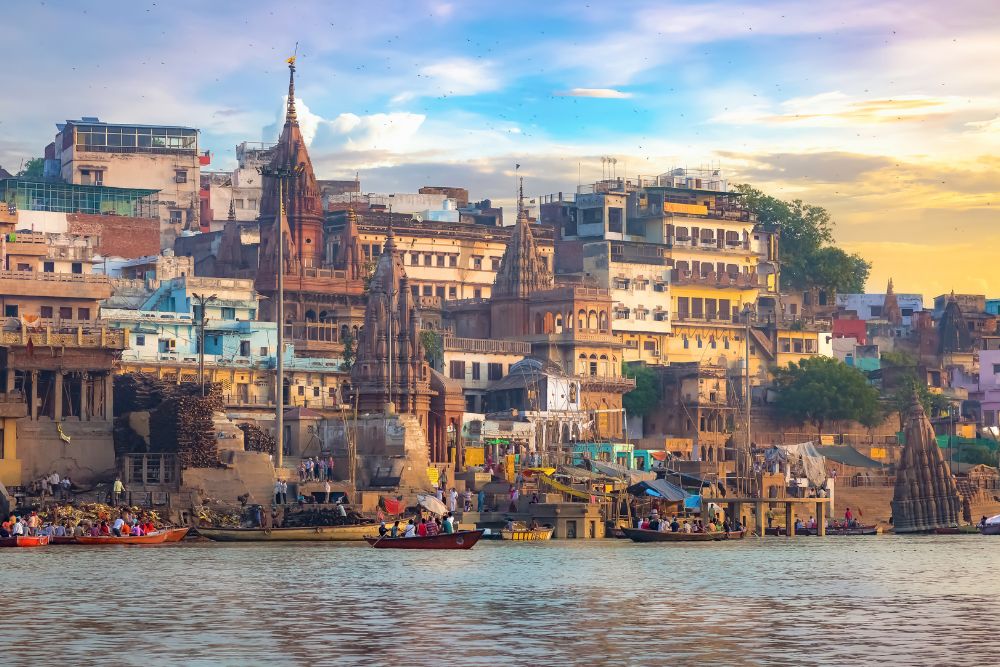
One of the oldest examples of this kind of practice is the Panchakroshi Yatra, a ritual walk around the city of Varanasi in India.
It is a route of about 108 kilometers, walked on foot, circling one of the most sacred places in Hinduism. For pilgrims, it is not a trip and not a physical challenge. It is a ritual of transformation that unfolds step by step.
Panchakroshi Yatra shows that sometimes the spiritual path is not about going farther, but about returning to the same place with a different awareness — an idea we also find in contemporary mindful-walking rituals, such as the Ritual of the 9.
History and tradition
Panchakroshi Yatra is mentioned in ancient texts from the Puranic tradition, especially in the Kashi Khanda, a text that describes the sacred geography of Varanasi. In these writings, the route is presented as a symbolic map of the cosmos, where each stop has spiritual meaning.
Traditionally, pilgrims walk the route in five days, though there are versions of three or seven days. During the journey, people walk, sleep in simple shelters for pilgrims, and keep a slow, almost ritualistic rhythm.
Speed does not matter. Continuity does.
Pilgrims stop at temples, sacred trees, or traditional places of prayer. Sometimes they keep silence. Other times they chant mantras or simply walk quietly.
With time, walking becomes a form of prayer.
The structure of the ritual
Panchakroshi Yatra has a simple structure, but one filled with deep symbolism.
The route forms a complete circle of about 108 kilometers around Varanasi. The number 108 is considered in Indian spiritual traditions a number of totality and return to the source.
The walk is done on foot, and the body becomes the main instrument of the practice. Each step creates a rhythm that calms the mind and brings attention into the present moment.
Along the route there are ritual stops — temples, springs, crossroads, or symbolically important places. A stop is not just a physical pause. It is a moment of awareness.
At the end, pilgrims return to the starting point. But they are not the same people who left. This is the essence of the ritual.
The circle as initiation
Parikrama, the practice of walking around a sacred place, is one of the oldest rituals in India. The idea is simple: you do not move away from the center — you move around it.
In Panchakroshi Yatra, the center is the city of Varanasi. But symbolically, the center is also inside each pilgrim.
By walking in a circle around the city, people slowly discover that the outer journey reflects an inner process. Each day of walking simplifies the mind. The constant rhythm reduces mental noise. Clarity and presence appear.
The circle becomes a form of initiation.
Walking as prayer
In many spiritual traditions, the body is directly involved in practice. In Panchakroshi Yatra, walking becomes a form of moving meditation.
The repetitive rhythm of the steps creates inner quiet. No complicated techniques are needed. The body already knows how to enter this rhythm.
After a few hours of walking, the mind begins to calm down. After a few days, a different relationship with time appears.
Time is no longer measured in hours, but in steps.
The symbolism of the number 108
The number 108 appears often in Indian spiritual traditions. Prayer beads have 108 beads. Some yogic practices include 108 breaths or 108 repetitions of a mantra.
In some symbolic interpretations, 108 represents a complete architecture of human experience — a cycle that includes beginning, process, and return.
In Panchakroshi Yatra, the 108 kilometers reflect this idea of a complete cycle. It is not just a distance. It is a metaphor for the entire inner journey.
Circular time
An important aspect of this ritual is that there is no final destination. The route is circular.
The pilgrim leaves from one place and returns to the same place. But the experience is not the same.
In many spiritual traditions, this idea appears again and again: transformation does not mean reaching a new place, but seeing the same place with a different consciousness.
The circle expresses this idea very clearly.
Beyond religion
Deși Panchakroshi Yatra aparține tradiției hinduse, structura lui este universală.
The idea of walking around a center appears in many cultures. We find it in Tibetan rituals of circling sacred mountains, in medieval labyrinths inside cathedrals, or in various urban ritual paths.
They all share a few common elements.
There is a symbolic center.
There is a path that surrounds it.
There is walking, stopping, and returning.
This structure also appears in contemporary forms of spiritual practice and in ritualuri urbane de transformare.
Sometimes as modern pilgrimages. Other times as personal or community rituals that use mindful walking as a tool for inner change.
In many processes of inner development, including systemic constellations, we see the same principle: life does not change through one spectacular moment, but through a process in which we return, look again, and integrate.
A bridge to contemporary rituals
Panchakroshi Yatra reminds us of something essential.
Transformation does not come from the destination. It comes from staying faithful to the path. When there is rhythm, repetition, and continuity, change appears almost naturally.
This is why many modern inner-work practices include similar elements: mindful walking, symbolic stops, simple rituals repeated over time.
Not for performance. For clarity.
In the end, Panchakroshi Yatra does not take you farther. It brings you back — in a circle large enough for you to see yourself more clearly.
Echo for the Ritual of the 9
When we look at Panchakroshi Yatra, we see a simple and universal principle: transformation appears when there is rhythm, repetition, and continuity..
It is not a path walked once. It is a ritual structure that unfolds over time.
The same principle stands at the foundation of the Ritual of the 9..
It is not about distance or performance. It is not about how far you go, but about how you return, again and again, to the same intention..
In Panchakroshi Yatra, the physical circle around the city creates an inner space of clarity.
In the Ritual of the 9, the nine successive stops create the same kind of inner circle..
Time becomes part of the ritual. Repetition becomes integration. And walking becomes reflection
Although it comes from a different tradition, Panchakroshi Yatra shows us the same truth found in many spiritual practices around the world: transformation does not come from one single moment, but from staying faithful to a consciously walked path..
In this sense, walking rituals — whether in India, Japan, or Europe — are variations of the same archetypal structure.
A center.
A circle.
A path walked with presence.
And a different return.
If this path stirred something in you, there might be a little more road ahead.
Nine Stops and a Journey Within is the journal of my own journey — nine thresholds, nine stops, written the way they were lived, not to impress, but to accompany. It's available as an ebook, in EPUB format, on Lulu — in both Romanian and English.
Read it in Romanian – Nouă opriri și un drum interior Read it in English: Nine Stops and a Journey Within
Share this article
Support the article library
If this article has been meaningful to you and you’d like to support this project, you’re welcome to make a voluntary contribution.
This contribution helps me continue writing freely and developing the resource library about body, soul, rituals, emotions, and inner transformation.