

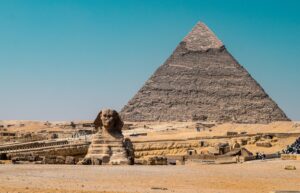
Mummification in ancient Egypt
Mummification in Ancient Egypt – the ritual that prepared the journey to the afterlife
Mummification in Ancient Egypt was not just a method of preserving the body. It was a ritual deeply connected to how the Egyptians understood life, death, and the continuity of the soul.
Archaeologists have discovered tombs and funerary practices over 5,000 years old, and the process of mummification became increasingly complex during the time of the pharaohs. In many Egyptian tombs, researchers found food, jewelry, figurines, and everyday objects placed beside the deceased. These offerings reflected the belief that existence continued in another form and that the soul needed support for its journey.
The body was prepared with great care:
- the organs were removed,
- the body was dried with natron,
- wrapped in bandages,
- and accompanied by symbolic objects for the “journey” to the afterlife.
For the Egyptians, death was not a complete disappearance.
It was a passage.
Scholars of religion note that many Egyptian funerary rituals were meant to help the soul continue its journey after death and to maintain the connection between the living and the departed.
In The Book of the Dead, one of the most well‑known collections of Egyptian funerary texts, we find formulas and rituals meant to guide the soul through this transition.
Egyptologist Jan Assmann wrote about the role of memory and funerary ritual in Ancient Egypt, showing that these practices helped preserve the bond between the world of the living and the world of the dead. And anthropologist Robert Hertz observed that funerary rituals are important not only for the one who dies, but also for the community that must integrate the loss and regain its balance.
Anthropologists say that funerary rituals exist in almost all human cultures because people have always needed:
- to make sense of loss,
- to mark separation,
- and to transform the chaos of grief into a gesture that can be lived together.
Perhaps this is why rituals surrounding death are so powerful. Because they speak not only about those who leave, but also about how those who remain try to continue..
👉 Is there a ritual or gesture through which you feel you keep a connection with someone dear?
👉 Is there a family tradition related to remembering those who have passed that you consider important?
