Psychogenealogy: a history of invisible memory
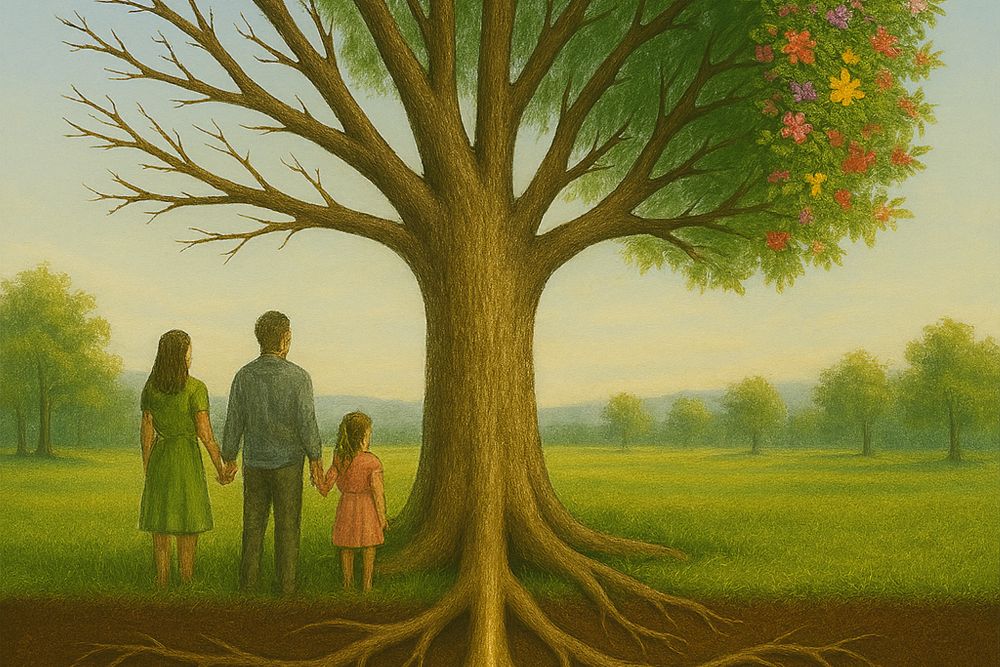
If these reflections resonated with you, you are welcome to share it further.
How a science of repeating destinies was born
From the intuitions of psychoanalysis to modern epigenetics: a journey through the ideas, authors, and revelations that shaped psychogenealogy.
Some fields are born from formulas, statistics, and laboratories.
And some fields are born from suffering, from repetition, from the question that appears in therapy rooms, in couples, in the body:
“Why am I living a story that isn’t mine?”
Maybe you’ve felt it in a relationship that resembles another too closely. Or in a fear that doesn’t seem to begin with you. Or in a blockage that returns, even after you believe you’ve understood it.
Psychogenealogy belongs to this second world. It is a living science, a map of family memory, a bridge between psyche, body, and destiny.
It didn’t appear suddenly. It wove itself slowly — from clinical observations, from intuitions, from stories that kept repeating in families without anyone understanding why.
This is its story.
Psychogenealogy — a timeline of years, contributions, metaphors
1900–1930 — The intuitions that prepared the ground
Sigmund Freud (1856–1939)
Contributions: unconscious repetition, repetition compulsion, transmission of unresolved conflicts.
Freud doesn’t speak about the transgenerational, but he lays the first stone: the idea that the psyche transmits what it could not process.
He notices that patients repeat the same patterns, the same relationships, the same failures. He names this phenomenon “the repetition compulsion.” “The patient does not remember… he repeats.”
Metaphorically, Freud opens the door to the idea that the psyche is a river flowing through generations — and what wasn’t integrated upstream returns downstream,in another generation.
Carl Gustav Jung (1875–1961)
Contributions: the collective unconscious, archetypes, symbolic inheritance.
Jung brings the symbolic dimension: the individual carries not only their own history,but also the history of their tribe. Sometimes this history appears as a vague sensation — an attraction, a fear, a repetition without a clear explanation. As if something from the past continues to live through you. “We are not only what happened to us, but also what our ancestors lived.”
His metaphor: every person is a room with many doors, and some of those doors open into the lives of those who came before.
1930–1960 — The child as carrier of family history
Françoise Dolto (1908–1988)
Contributions: he family unconscious, emotional transmission in the parent–child relationship, the child as “the symptom of the family.”
Dolto observes that a child can express through body and behavior what the family cannot speak. She says: “Everything that is not spoken in the family is inscribed in the child’s body.”
A classic Dolto example: A child with severe anxiety becomes the carrier of the mother’s fear — a fear the mother cannot express. The child does not “invent” the symptom. He expresses it. He becomes the place where what was unspoken finally begins to show itself.
Dolto prepares the ground for the central idea of psychogenealogy: unlived emotion does not disappear — it is transmitted.
1950–1970 — Family secrets and transgenerational communication
Nicolas Abraham (1919–1975) & Maria Torok (1925–1998)
Contributions: the concepts of the “phantom” and the “psychic crypt.”
They develop the idea that unspoken traumas do not vanish — they are sealed inside the psyche as a crypt. These become “psychic ghosts” that influence later generations..
Not as a known story, but as a diffuse presence: a nameless unease, a disproportionate reaction, an inexplicable emptiness.
Metaphorically: what is not lived and integrated does not die— it continues to live in someone else.
Serge Tisseron (n. 1948)
Contributions: “psychic ghosts,” the effects of family silence.
Tisseron shows that secrets do not disappear. They become psychic entities transmitted forward, shaping anxieties, behaviors, choices.
He writes: “What is hidden in one generation becomes a symptom in the next.”
His metaphor: a secret is like a closed room in a house;even if no one enters, the child will still smell what seeps out from under the door.
The Palo Alto School (1950–1970)
Gregory Bateson (1904–1980) & Paul Watzlawick (1921-2007)
Contributions: communication theory, systemic approach, relational circularity.
Bateson, Watzlawick, and their team introduce the idea that the family is a living system, with rules, roles, and circular dynamics. A symptom does not belong to one person — it belongs to the entire system.
This shifts the perspective: we no longer ask “who is the problem?” but what in the system is trying to express itself through this symptom?
Their metaphor: the family is a mobile hanging from the ceiling — touch one piece, and all the others move.This becomes foundational for psychogenealogy.
1970–1990 — The birth of psychogenealogy as a distinct method
Ivan Boszormenyi-Nagy (1920-2007)
Contributions: invisible loyalties, relational ethics.
Before the term became popular, Boszormenyi-Nagy introduces the idea that family relationships are governed by an invisible “ledger” of loyalties.People remain faithful to their family system even when this limits their life.
Often, this loyalty is not conscious. It is felt as an inner truth: “this is just who I am.” Only when you see it does distance appear. And sometimes, choice.
Metaphor: invisible loyalty is an unspoken promise — the child carries it forward without knowing it isn’t theirs.
This perspective becomes one of the foundational pillars of modern psychogenealogy.
Anne Ancelin Schützenberger (1919–2018)
Contributions: founder of psychogenealogy, the genosociogram, anniversary syndrome, invisible loyalties.
Schützenberger gives the field its name. She observes that people repeat ages, dates, and destinies of their ancestors.
Her famous quote: “We are less free than we think. A part of our life is lived by those who came before.”
She creates the genosociogram — a living, emotional family tree that reveals:
- repetitions
- ruptures
- alliances
- exclusions
- unconscious loyalties
For many, this is the first moment when patterns become visible — not as theory, but as recognition.
Her metaphor: “The family is like a river: if you don’t know the springs, you cannot understand the flow.””
Josephine Hilgard (1906–1989)
Contributions: anniversary reactions, unconscious age-linked repetitions.
Hilgard studies how certain symptoms appear at the same ages across generations.She observes that people may enter emotional crises at the age when an ancestor experienced trauma.
Example: A man falls into depression at 40 — the age at which his father died.
Hilgard names this phenomenon the “anniversary reaction.”
1990–2000 — Expansion and symbolic opening
Alejandro Jodorowsky (n. 1929)
Contributions: poetic psychogenealogy, psychomagic, integrating art into healing.
Jodorowsky brings psychogenealogy into the public space. He makes it accessible, ritualistic, symbolic. He shows that sometimes healing needs gestures, not only words.
His metaphor: “A wound does not heal only by talking about it. Sometimes it needs a poetic act.”
This symbolic opening prepares the ground for modern experiential approaches.
2000–2010 — Modern integration
Psychogenealogy meets:
- family constellations (Bert Hellinger)
- body psychotherapy
- hypnosis
- transpersonal approaches
A new integrative practice emerges: psyche + body + symbol + system.
Psychogenealogy begins to move from explanation into experience.
Bert Hellinger (1925–2019)
Contributions: family constellations, systemic order, the laws of love.
Hellinger brings psychogenealogy from understanding into direct experience. He observes that family dynamics are not only told — they can be seen and felt in space, through the relationships between members of the system.
He introduces the concept of systemic order — the idea that each person has a place in the family, and imbalances appear when this order is disrupted: through exclusions, role reversals, or unconscious loyalties.
Through constellations, what was abstract becomes visible: relationships, tensions, invisible bonds take form and meaning.
Metaphor: the family system is a living field — even if you don’t see it, it influences every step.
2010–2020 — Epigenetics confirms what clinicians already knew
Modern research shows that trauma can alter gene expression and may be transmitted across generations.
Studies by researchers like Rachel Yehuda reveal how extreme experiences leave biological traces that can be inherited.
One of the most well-known examples comes from research on Holocaust survivors and their children. It has been observed that they show changes in the stress response system—particularly in cortisol regulation, the hormone associated with survival responses.
Moreover, these changes do not appear only in those who directly experienced the trauma, but also in the next generation. The children of survivors may show increased sensitivity to stress, anxiety, or intense emotional reactions, even without having gone through the traumatic experience themselves.
This is not “conscious memory,” but a biological imprint — a way the body learns from an extreme experience and passes on that adaptation.
These studies do not explain the full complexity of transgenerational transmission. But they offer an important insight: the body can carry traces of experiences that were not directly lived.
They do not explain everything. But they open an important bridge—between body and history, between biology and experience, between what we live and what we carry forward. It is the first time molecular science begins to confirm what psychogenealogy has long observed clinically.
Metaphor: “Genes are the letters, but life writes the text.”
2020–present — Contemporary psychogenealogy
The field expands into:
- constellations
- somatic therapies
- systemic coaching
- personal development
- epigenetic research
Psychogenealogy becomes a living, fluid, continuously evolving method.
It is no longer just a theoretical framework, but a working space where people can look at their history, understand it, and sometimes place it differently inside themselves.
Maybe it’s not about understanding everything. Maybe it’s about recognizing what you carry. And slowly beginning to see what belongs to you — and what doesn’t.
If this part is about history, the next is about mechanisms.
We will explore:
- the family unconscious
- invisible loyalties
- repetitions
- secrets
- the body
- repair
Read : Part II – The conceptual map of psychogenealogy
Frequently asked questions
What is psychogenealogy, in short?
It is the study of how experiences, traumas, and family patterns are transmitted across generations and influence our present life.
Is psychogenealogy a science or a therapeutic practice?
It is interdisciplinary. It has roots in psychoanalysis, systemic psychology, and modern research (epigenetics), but is applied mainly as a therapeutic and personal exploration practice.
What does transgenerational transmission mean?
It refers to how emotions, traumas, or unresolved patterns in one generation can influence the behaviors and experiences of the next.
What is the difference between psychogenealogy and family constellations?
Psychogenealogy offers understanding and mapping. Constellations offer direct experience and transformation in relation to the system.
Is psychogenealogy scientifically proven?
Some aspects, like trauma transmission, are supported by epigenetic and neuroscience research. Others remain in the clinical and experiential realm.
How do you know you’re living a transgenerational pattern?
Sometimes it appears as repetition: the same types of relationships, the same blockages, the same intense emotions without a clear cause in the present.
Why do some things repeat even if you understand them?
Because understanding is only the first step. Some patterns are supported by deep loyalties or systemic dynamics that need more than clarity to transform.
Constellations and systems - psychogenealogy and transformation
Your journey begins with a choice - family constellations
Maybe we cannot change the past, but we can change the way we carry it. And sometimes, that changes everything.
Share this article
❤️ Support this library
If this article has been helpful to you and you feel it deserves support, you can contribute with a symbolic donation.
It helps me continue writing freely and developing this library of resources about the body, emotions, rituals, and inner transformation.